“No one in the state asked for it,” said Kelly Wood, senior counsel of the Washington Attorney General’s Office, regarding a recent federal order requiring that a coal plant in Centralia re-fire its final standing boiler.
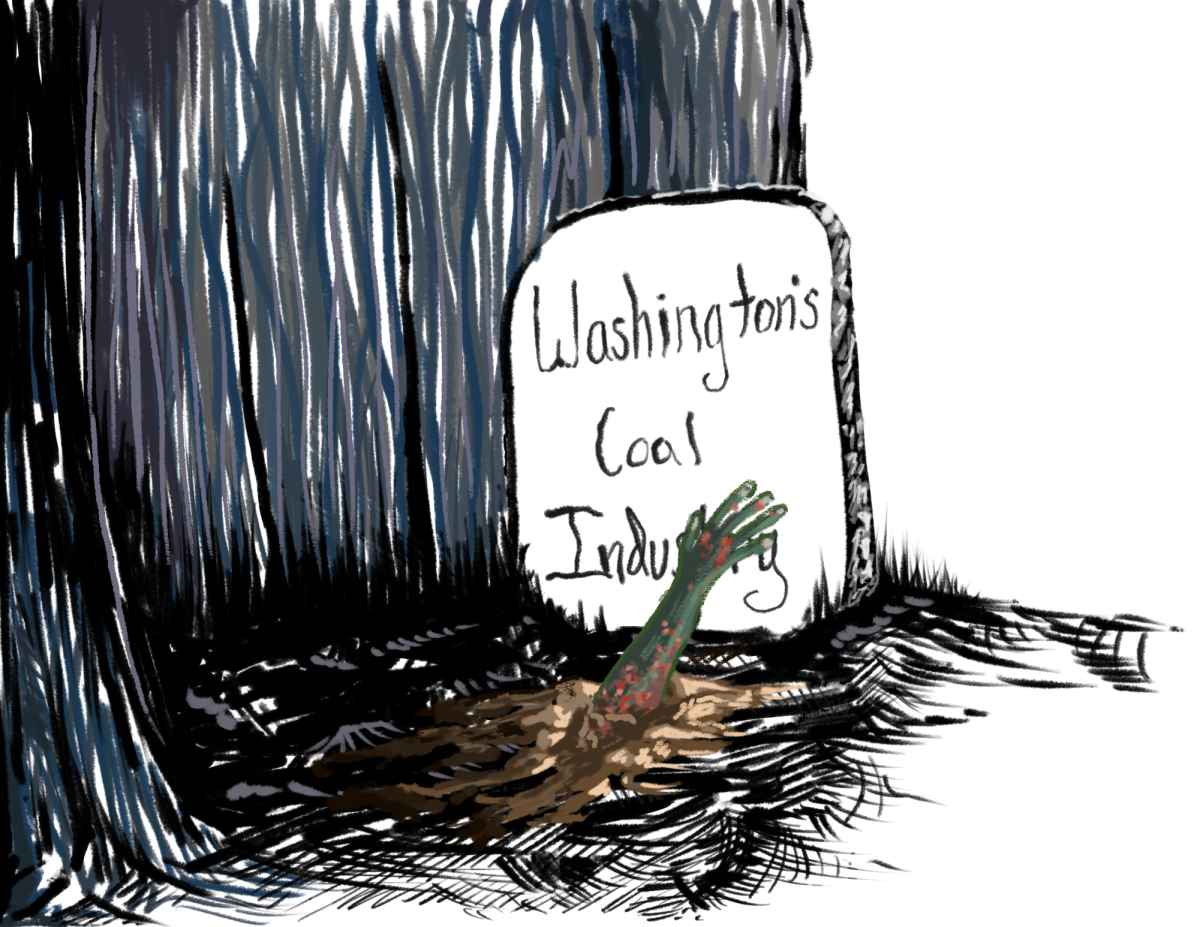
The plant, owned by Canadian energy company TransAlta, loomed as a final testament to coal-powered generation in Washington. It produced approximately five times the amount of Los Angeles’ monthly electricity consumption since its opening in 1971, but ultimately left behind a deeper legacy of contamination.
For decades, the TransAlta plant was the single largest contributor of greenhouse gas emissions in the state. It supplied 10% of carbon emissions in 2010, as well as a slew of sulfur, nitrogen oxides and heavy metals. This pollution — along with the clouds of smoke that created strong regional haze in the Mount Rainier area — paved the road for the plant’s slow termination.
The TransAlta facility’s coal operations have been penned to shut down since the Washington state legislature passed a resolution in 2011, which had the first of two coal boilers closed in 2020 and the second on Dec. 31, 2025. In exchange for the shutdown, TransAlta was allowed to run the facility with certain exemptions from air quality and coal testing standards.
Bob Guenther, a former plant employee and member of the International Brotherhood of Electrical Workers, said in an interview with The New York Times that these negotiations were “something unusual.”
“Look across the country and find another company that has sat down with the environmental community and the labor community and the government community to develop a plan for the long term… it hasn’t happened,” Guenther said.
For years, the compromises laid out between Governor Jay Inslee, the Department of Ecology, and the Washington legislature continued according to plan. Grid data even suggested that Centralia closed its second boiler 12 days before the scheduled cut-off date.
But the US Department of Energy had other ideas. Issued on Dec. 16, 2025, Order 202-25-11 mandates that the Centralia plant immediately re-fire its second boiler for the next 90 days.
The order cites section 202(c) of the Federal Power Act in order to declare an “energy emergency” in Washington. It posits that wind, solar and other renewable sources are “inadequate” to meet the state’s growing needs. It also makes good on two of Trump’s early executive orders.
However, the Washington Attorney General’s Office is not so convinced. Kelly Wood is a senior counsel attorney on the team who sent a request for rehearing on Jan. 13, 2026, in response to the order. The Trump administration has until Feb. 12 to respond to the request before the Attorney General’s Office can open the doors to test the order’s legality in court.
In an interview with The Wire, Wood explained that the Centralia plant is considered an aging plant, making it expensive and unfeasible to reinstate coal systems. Moreover, she argues that prioritizing coal power at the expense of cheaper and cleaner renewable sources will only create an inevitable energy affordability crisis.
Beyond costs, the rehearing request maintains that the order is illegal. Section 202(c) grants Energy Secretary Chris Wright the authority to stabilize the power grid for up to 90 days in cases of severe emergency — wildfires, hurricanes, extreme weather or wartime conditions. Even as climate change has had some impact on Washington’s energy supplies, grid data does not suggest that the state has experienced such shortages to suggest that coal is an optimal solution.
That said, many in the Trump administration, as well as Executive Order 14262, “Strengthening the Reliability and Security of the United States Electric Grid,” speak to the need to rapidly increase energy supply as a result of artificial intelligence’s ongoing expansion and construction of hundreds of data centers around the country.
Professor Rosie Mueller, who teaches a course at Whitman this semester on “Energy Economics,” agrees that a recent AI boom, along with the rising popularity of electric vehicles, has strained modern energy infrastructure.
“EVs in particular increase overnight energy demand since many people are charging their vehicles at home,” Mueller said.
“We do not deny that there are energy needs coming our way in the future that need to be addressed,” Wood said.
He explained that Washington is “working to fill that gap” through a combination of renewables and natural gas.
In fact, the termination of TransAlta’s coal operations in Centralia marks the beginning of the facility’s transition to natural gas generation as laid out in the 2011 TransAlta Energy Transition Bill. With finalized natural gas infrastructure estimated to be completed in 2028, the company signed a contract with Puget Sound Energy in 2025 to run for 16 years.
Though coined as a less carbon-intensive fossil fuel source, natural gas’s environmental impacts are still controversial. Drilling and extraction processes associated with natural gas and transportation through pipelines leak high amounts of methane, which has proven to be 34 times more potent than CO2 in trapping heat over a 100-year period.
Nevertheless, the vast majority of Washington’s energy comes from renewable sources, which often do not have the same storage capacity as their fossil fuel counterparts. Reservoir systems in hydroelectric dams grant increased storage capacities, but shifts in drought, snow melt and extreme precipitation due to climate change can create chronic low flows or flows so high that the water needs to be released without generating power. Hydroelectric dams are also highly controversial because of their detrimental impacts on salmon populations and Pacific Northwest ecosystem health.
Currently, solar and wind do not present hopeful alternatives.
“While the capacity for storing energy produced from solar and wind is increasing, the electricity grid still needs a reliable source of dispatchable (i.e., on-demand) electricity production, which natural gas can provide,” Mueller said.
Wood argues that TransAlta’s transition to natural gas would generate critical back-up energy to fill the power gap while allowing the plant to more effectively work within the Climate Commitment Act.
The Climate Commitment Act is a key piece of Washington legislation that aims to reduce greenhouse gas emissions by 95% by the year 2050. The act’s cap-and-invest program, which sets high fees for companies that exceed the gradually decreasing emissions caps, would make DOE’s order to re-fire the coal boiler a high cost for TransAlta to bear. The company still has not made a public comment on the order or its implications, but is still projected to begin natural gas operations in 2028.
Ultimately, however, the Climate Commitment Act will aid Washington in phasing out greenhouse gases completely, including natural gas.
With this in mind, it can be argued that promoting energy efficiency and reducing energy waste throughout the state may be a better priority than constantly seeking new, soon-restricted avenues of generation. Washington could impose restrictions on energy usage, especially in highly intensive sectors like technology and artificial intelligence. In 2025 alone, AI data centers in Washington used four terawatt hours — enough to power nearly 400,000 homes for a year.
But energy efficiency or restrictions may not be a perfect fix on their own. Professor Mueller explained that in the U.K., there has been recent resistance to using air conditioning given its associated emissions and high energy consumption. However, this poses serious health risks in the face of rising temperatures and extreme heat exposure.
“The messaging should be on keeping electricity affordable,” Mueller said. “[This] means supporting wind and solar adoption and [research and development] into better storage technologies.”
The Trump administration, however, has made it clear that wind and solar development are not a priority. Hundreds of wind and solar farms have been stalled, defunded or dissolved since 2024 by the Trump administration. The administration also terminated the $7 billion Solar for All program, which delivered cheap and clean energy to low-income communities around the US.
It is with this in mind that the Attorney General’s Office remarks that energy stability is not a likely motivation behind the DOE order.
“We believe that this emergency is pretextual,” Wood said. “[This order] is less about energy needs and more that this administration has a stated goal of saving coal.”
Indeed, an early executive order from the Trump administration aims to boost “beautiful clean coal” throughout the country by promoting extraction operations and removing restrictions to mine on federal lands, among other means. Trump also recently revived the National Coal Council, an advisory committee to the Secretary of Energy, which dissolved under Biden.
Oil and coal groups have similarly returned these vested interests to the administration. A 2025 report found that fossil fuel-affiliated groups poured $445 million into influencing the 2024 election cycle. $96 million of those funds funneled directly into Trump’s 2024 re-election campaign.
“You don’t have to be a cynical person to see this order for what it really is,” Wood said.
Washington is not the only state that has received one of these orders, either. In the past eight months, the Federal Power Act has been used to declare energy emergencies in Michigan, Colorado, Pennsylvania and Indiana to force the closing coal plants to stay burning.
In Michigan, the DOE sent three consecutive 90-day orders to force the J.H. Campbell Plant to reopen. Wood said that Washington “fully anticipates” the administration will do the same to mount pressure surrounding Centralia.
“We’re ready to take whatever actions are necessary to ensure that this order is overturned,” Wood said.
Several organizations have sided with Washington against the order, including groups like Earthjustice, Environmental Defense Fund, Sierra Club, NW Energy Coalition, Climate Solutions and Washington Conservation Action. Thus far, no organizations within the state have publicly sided with reopening the plant.
Ultimately, however, TransAlta is one of dozens of ongoing environmental battles Washington has been challenging the federal government on since 2024. The Attorney General’s Office is also contending for slashes to electric vehicle infrastructure and clean water regulations. The EPA has additionally expressed interest in rolling back the Endangerment Finding, which classifies fossil fuels as harmful to people and the environment and serves as the backbone to thousands of environmental policies around the country.
“They didn’t have the authority to do what they did,” Wood said. “Who knows what they’re going to do next.”
In the meantime, Washington is ready to fight.