
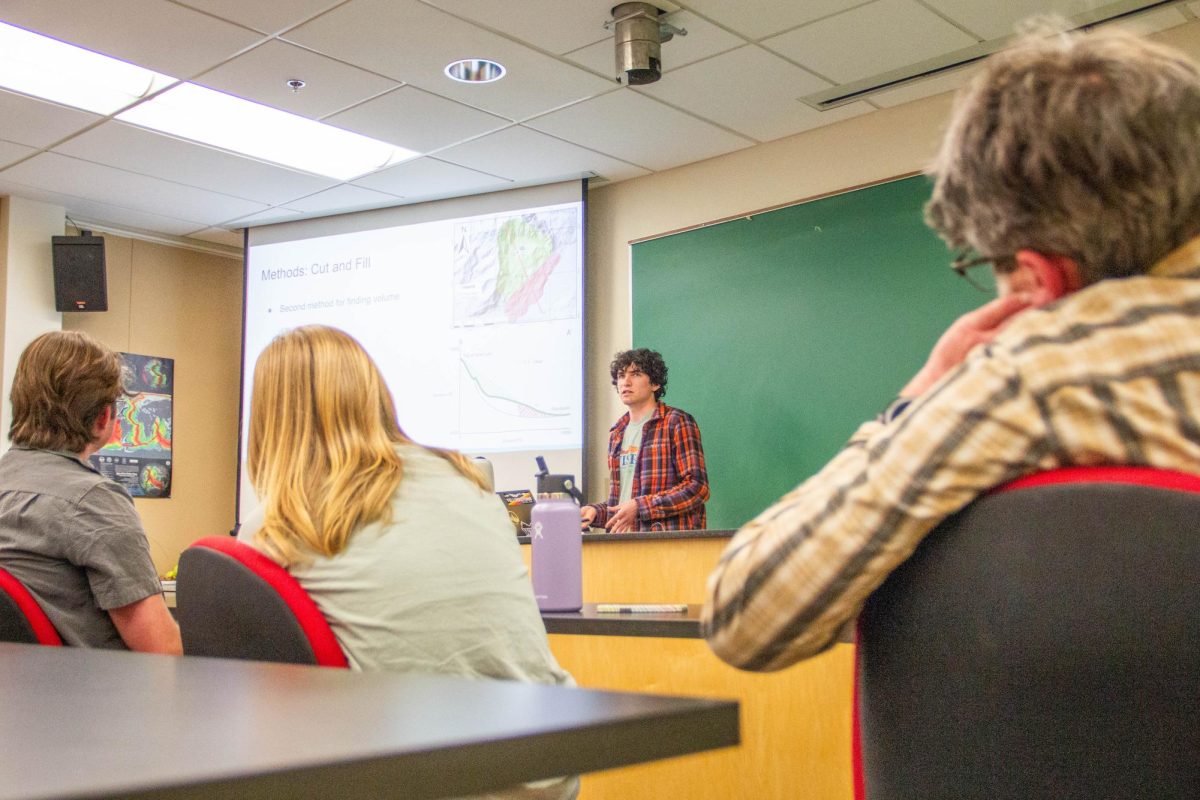
On Tuesday, April 14, the campus’s regular affairs were put on pause for the 28th annual Whitman Undergraduate Conference. The conference, often referred to as “the WUC,” is a day where Whitman student research coalesces and their hard work is shared. This year, students, faculty and community flocked to campus to learn from and celebrate the work of over 160 Whitties.
The Whitman Undergraduate Conference (WUC) showcases work across every discipline through presentations on work in the humanities, posters on scientific research and artistic performances alike. It’s an opportunity for students to share their own novel research, answer questions from peers and professionals and celebrate their accomplishments during their time at Whitman. This opportunity is especially important for students in the sciences, as science communication is often an underemphasized aspect of the field.
Ben Todd ’26 is a senior Geology major with a natural curiosity about Earth’s processes.
Todd made the decision to pursue a thesis on his own accord, as theses are not required for Geology majors. He worked with Associate Professor of Geology and Environmental Studies Lyman Persico to investigate how measuring the volume of displaced material from landslides can reveal the temporal relationships between these geological events and the movement of glaciers. In his project, Todd set out to determine how much the observed volume of material displaced in landslides in Northeast Yellowstone varies from the expected volume to determine an “order of events” between landslides and glacial erosion. He did this using two methods: a Python tool called Sloping Local Base Level and ArcGIS Pro volume mensuration. His results were inconclusive, revealing large inconsistencies between the calculations of the two methods. Though many would be discouraged by this result, Todd instead used them as a way to make clear the next steps and carve out a larger goal for future researchers to pursue.
“The ultimate goal of this research is to develop methods that allow us to consistently measure the volume of landslides of all sizes and their deposits with only elevation data,” Todd said.
The WUC affords the chance to present original scientific research in a professional setting, an opportunity which isn’t always available to students early in their academic career.
Keenan RiggsTurpin ‘27 is a Junior Chemistry major. He arrived at Whitman knowing he wanted to participate in research as an undergraduate and eventually joined Associate Professor of Chemistry Mark Hendricks’ lab. RiggsTurpin earned the 2026 Barry M. Goldwater scholarship, a prestigious award for students of science, engineering and math.
“I took every chemistry class I could take and talked with my professors about their research. I was ecstatic when I was invited to join the Hendricks lab,” RiggsTurpin said.
His work deals with quantum dots – nanocrystals used in both scientific contexts like solar cells, biomedical imaging, catalysis and quantum computing, as well as in everyday-life applications, such as TV displays. Specifically, RiggsTurpin studies the synthesis of zinc sulfide quantum dots, a type of dot that is non-toxic and biocompatible, which broadens not only its list of potential uses, but also the ways its growth and size can be controlled.
Unlike other nanocrystals, the growth rate and size of these zinc sulfide quantum dots was found to function independent of the chemical precursors used in their synthesis. Through his research, RiggsTurpin found that destabilizing the nanocrystal cluster intermediate allows for more control over the final size of zinc sulfide quantum dots.
For RiggsTurpin, the Undergraduate Conference was both a celebration of his hard work and a way to prepare him for the future.
“I chose to participate in the Undergraduate Conference because I know that presenting your research is an invaluable skill for those pursuing graduate school and a career in research and academia. I decided to give a talk because it scared me, and I felt like the Conference was a supportive space to practice my public speaking and presentation skills,” RiggsTurpin said.
The Conference also creates a space for students to discuss broader issues that their fields of study face in the modern world.
Jack Bingaman ‘27, a junior Physics-Astronomy major, expressed an early interest in radio astronomy during his time at Whitman. After hearing about a project started by a former Whittie that involved studying the “forbidden” 21-cm spin-flip transition, he contacted Assistant Professor of Astronomy Jessica Sutter to get involved.
His research involves using a relatively small antenna resembling a clothesline, lovingly named Omar, to capture the Milky Way’s emission at the 21-cm line. The eventual goal is to map how the Milky Way is moving, an effort that will require several years worth of student work and data collection.
Bingaman’s presentation stretched beyond his findings, emphasizing broader issues in the field of radio astronomy as humankind’s footprint expands into space.
“Astronomy is — and should continue to be — as accessible as looking up on a clear night. The first telescopes were our eyes, and even those observations are being literally outshined by streetlights and satellites… We have been granted the privilege of a lifetime to see our vast and stunning universe on one of her most beautiful planets and I’d like to keep it that way. So if that means less glittery satellites, I’m all for it,” Bingaman said.
Other students shared findings from research conducted off-campus and around the world during summers or semesters abroad.
Biology major Tatum Huegel ‘26 presented findings from her summer research carried out near the Arctic Circle on Alaska’s North Slope. Her work was part of a National Science Foundation-funded Research Experience for Undergraduates. During her time in Alaska, she worked with professionals, researchers and students from across the country.
In the tundra of the North Slope, larger bodies of water are regularly monitored for their dissolved organic carbon and nitrate dilution throughout the year in order to track and assess the nutrients flowing into the Beaufort Sea. Huegel worked to fill a gap in this data by using autosamplers to collect high frequency data from smaller rivers.
She found that the two smaller rivers she studied varied greatly in their concentrations of dissolved organic carbon and nitrate, carving a path for future research investigating the surrounding environment and watershed slope as a predictor of these nutrient levels.
Huegel shared many of her peers’ reasons for presenting at the WUC, saying it allowed her to practice her presentation skills and show off her work in a “low-stakes” environment.
The Conference is not just for upperclassmen, either. Students at every stage of their academic undergraduate careers are represented.
Mas Ra’ed Aldardasawi ‘28 is a sophomore Biochemistry, Biophysics and Molecular Biology major who presented not on traditional research, but on a course she designed and taught last semester under the guidance of Professor Heidi Dobson and Professor Amy Molitor titled “Sick Planet, Sick People.” The course was inspired by her lived experiences of how peoples’ environment impacts their health. Aldardasawi’s perspective on this issue is impacted by her upbringing in Jordan, her years at the United World College campus in Hong Kong and her current time in rural Eastern Washington.
She discussed some of the case studies the course covered, including chronic kidney disease of unknown origin in young agricultural workers and dangerous white phosphorus pollution caused by military explosives. Additionally, she highlighted community-informed and community-based solutions to these often man-made issues.
Beyond sharing data, the WUC is about making connections and sharing powerful ideas. Aldardasawi’s focus on education shaped her experience at the conference.
“[‘Sick Planet, Sick People’] was built around conversation, around making complex ideas about environmental health accessible and engaging and the WUC felt like a natural space to continue that… not just by sharing research, but by sharing an educational model that encourages students to take ownership of learning,” Aldardasawi said.
The Whitman Undergraduate Conference is a central component of Whitman’s liberal arts mission, both for students who present their research and for those who spend the day learning from peers. It provides an opportunity for experiential learning, for students to build important communication skills and fosters an environment for students from every corner of campus to share their work and passions.


Albert Schueller • Apr 25, 2026 at 8:35 am
Let’s also direct our appreciation to the many people and their efforts that helped to make the undergraduate conference a success this year. It’s quite a group effort:
The 109 students that did individual or group presentations and to the 54 students that did poster presentations as well as their faculty/staff sponsors. (see the program for those names)
The conference organization was carried out by the Student Life Committee the members of which are:
Matthew Anderson (student), James Barrow (student), Callie Gilchrist, Beckett Gray (student), Ruoning Han, Olivia Jensen (student), Helen Kim, Erika Langley, Aimée Milne, Kristine Nwokoma (student), Chase Schubert (student).
The session moderators for keeping us on time and engaged:
Andrés Aragoneses, Bina Arch, Nick Bader, Susanne Beechey, Sarah Bolton, Alissa Cordner, Rachel George, Jessica Hines, Tim Machonkin, Lydia McDermott, Brit Moss, Sabrina Mostoufi, Lyman Persico, Michael Simon, Wisnu Sugiarto, Jessica Sutter, Chris Wakefield, Jordan Wirfs-Brock .
The poster printing by Peter Shultz.
The library preparation and poster organizing by Julie Carter and Emily Pearson (and other library staff).
The moving of poster stands and other furniture by Victor Saldana and the Conferences & Events staff.
The musical performances organized by Laney Armstrong, Amy Dodds, and Susumu Watanabe. (see the program for the names of the individual performers)
The communications support by Ryan Barnes, Michael Cox, and Bradley Nelson.
The talented artist Clara Crandall (student) who created our conference poster this year.
The building logistical support by Richele Heilbrun, Debi Morehead, and Noémie Studer.
The classroom media/tech support by IMS staff: Jon Loney, Haley Lowery, and Tristan Rupert
The custodial staff in Maxey, Olin, Science and the Library for preparing the buildings and getting them back into shape for classes tomorrow.
The lunch by BonApp staff.
The College for funding it all!
And, the community for showing up to support all of these students as they share their work.
Albert Schueller
Chair of the Student Life Committee