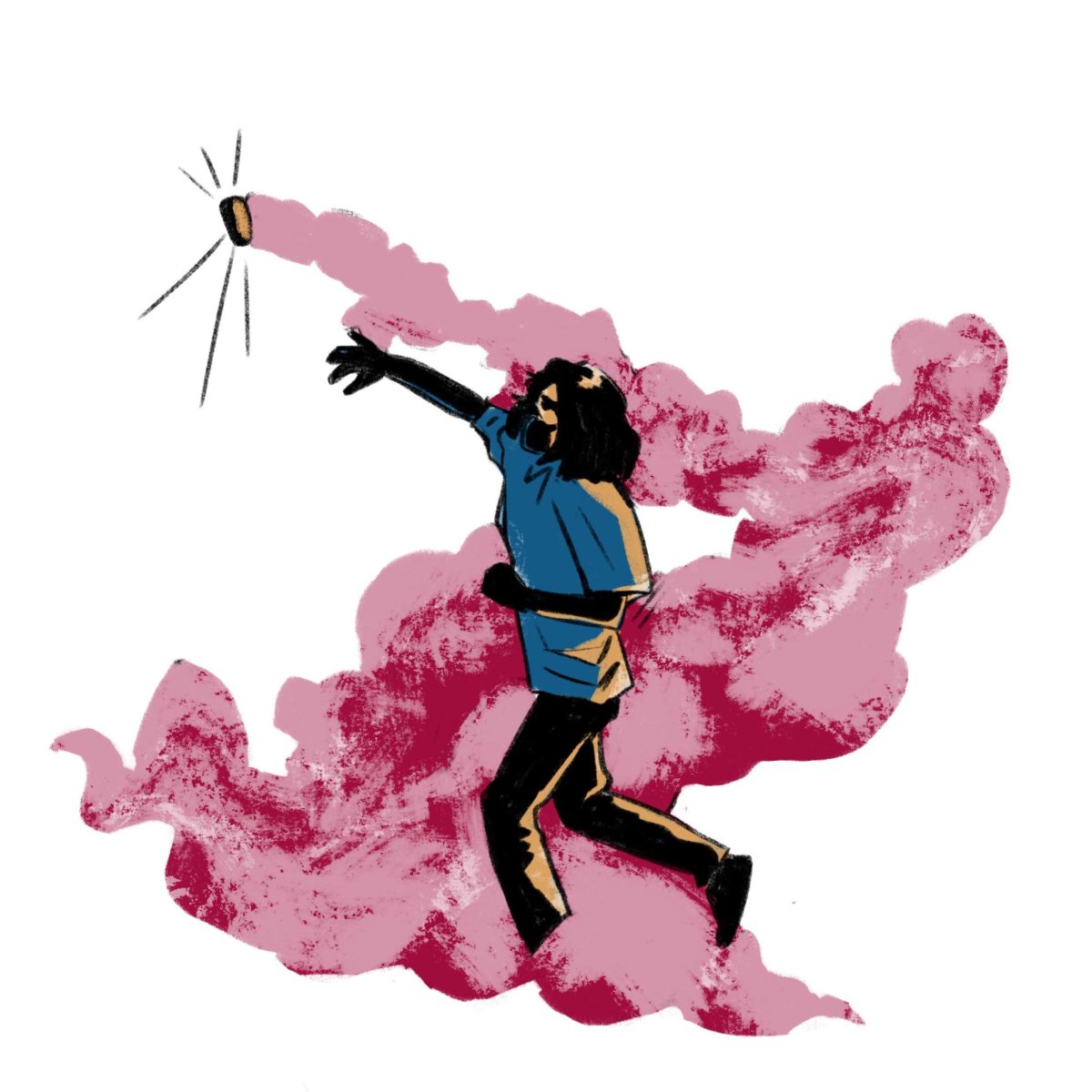
Chicago. Minneapolis. Portland. Three cities that are hundreds of miles apart, but whose thick clouds of noxious smoke mark them as profoundly interwoven.
Since the beginning of 2026, apartment residents have gone to sleep wearing gas masks. Mothers have performed CPR on their months-old babies. Elementary school teachers have learned to carry whistles and evacuate their students from playgrounds. Empty canisters, burned grenades and pepper ball shells litter streets alongside flattened cardboard signs and crumpled American flags.
The culprit: enough tear gas deployed to create instantaneous asthma attacks, spontaneous menstrual bleeding and temporary blindness.
“Tear gas” is not a single chemical composition but an umbrella term encompassing numerous chlorine-based compounds. These compounds are not technically a gas but a crystalline white powder, which law enforcement disperse hundreds of feet towards crowds via exploding canisters, water cannons and aerial sprays.
The most common tear gas compound is chlorobenzylidenemalononitrile “CS”, which triggers pain receptors along the inner airways, heart linings, gastrointestinal tract and vascular system. The main pain receptor CS gas targets is TRPA1, which, among other reactions, drives the same physical responses to wasabi. But the chemical packs a much harder punch: according to Duke Anesthesiology Professor Sven-Eric Jordt, CS gas induces a sting up to 100,000 times stronger than that of wasabi.
Despite tear gas’s effects — crying, coughing, vomiting, choking and chemical burns (to name a few) — the compound is advertised as a non-lethal method of crowd control. Still, tear gas has been banned for use in international warfare since the 1990s, yet it is still readily used against protesters in the United States and dozens of other countries.
“The state famously has the monopoly of violence,” said Professor Lund-Montano, who teaches a course at Whitman on the history of US protest and organizing. “It’s only the state who has the capacity to order violence in order to quell violence.”
Legally, enforcement officers can use these weapons against protesters if the assembly becomes violent, but the line between peaceful protest — protected by the First Amendment — and aggressive riot is one that officers often draw in the aftermath.
“The term riot has [historically] been used to imply uncontrolled violence that therefore needs to be subdued, ” Lund-Montano said. “[Using riot] especially de-politicized violence in the sense that [it implies] no clear goal or target.”
Though the hundreds of protests in 2026 vary by city and situation, many raise pressing concerns about the long-term health effects that deploying this much tear gas will create. As a crowd control method, tear gas is far-reaching and indiscriminate, seeping into nearby buildings and vehicles. There’s also little to no transparency on the substance’s exact chemical compositions, or federal standards to ensure ‘safe’ use, so diagnosing any impacts is doubly difficult.
“No large, systematic studies have investigated the health problems that emerge long after exposure to these chemicals,” said Anthony Szema, chair of the American Thoracic Society’s Section on Terrorism and Inhalation Disasters, in an interview with ScienceNews. “For weeks and even months after the immediate moments of exposure, crowd control agents may continue to sabotage the organs that allow us to breathe, pump blood and even make life.”
Moreover, a study conducted in 2014 on over 6500 army recruits revealed that the likelihood of contracting a serious respiratory illness, such as influenza, bronchitis, pneumonia or other diseases, more than doubled post-exposure and that effects increased with repeated exposure. This research has been the foundation for guidelines warning against long-term exposure, but studies have only sampled from young and healthy men, leaving gaps regarding the unique dangers for other, more vulnerable groups.
Professor Asha Hassan, with the University of Minnesota and a group of researchers, discovered that 83% of people with uteri who were exposed to chemical agents reported at least one adverse reproductive outcome, and that exposure for more than five days created 2.6 times more negative reproductive outcomes. Common reports included intense uterine cramping, early or delayed menstrual bleeding and breast tenderness. Some who were exposed began spontaneously menstruating after having not experienced it in years due to birth control or hormone use.
Hassan now hopes to examine the gas’s impacts on pregnancy, which studies of animals and reports from pregnant women in the Arab Spring protests in Egypt have indicated an increased likelihood of miscarriage. Whether these results were attributed to stress, shock or chemical exposure remains unclear.
“I repeatedly was getting emails from health care providers who had noticed more preterm birth,” said Hassan in an interview. “I’m hoping to be able to explore that and get an understanding if there are population-level changes.”
After ongoing 2024 protests against Georgia’s parliament, Konstantine Chakhunashvili and others embarked on a mission to examine cardiovascular impacts. Ultimately, they found that long-term tear gas exposure, especially in enclosed environments, slowed the body’s electrical impulses, reduced blood flow and increased the chance of heart attack. Even the federal government’s own breakdown of the compound explains that long-term exposure could increase the risk of vision loss or glaucoma.
In this context, one’s decision to protest could lead to serious and lasting medical damage years down the line, depending on the level of exposure. For hundreds of bystanders in downtown Portland, this decision was already made for them.
On January 31, a federal immigration officer chucked a projectile chemical weapon towards a Portland apartment building. The projectile broke a resident’s window, flooded into the apartment and caused the inhabitants, a Yemeni-born woman and her mother, to vomit profusely.
This is only one story of dozens at Gray’s Landing, an affordable apartment complex located less than 100 feet from a US Immigration and Customs Enforcement building in Portland, which has filed a lawsuit against the federal government for excessive and indiscriminate tear gas use impacting the building’s residents.
In response to widespread and months-long protests outside the ICE facility, immigration officers have deployed tear gas and other chemical weapons repeatedly, sometimes multiple times a day. Particles have seeped through residential windows and under doors, adhering to carpets, walls, clothing and furniture. Many CS gases use silica as a binding agent, which can make toxins more persistent and near impossible to clean away.
In the meantime, residents are trapped in dangerous conditions, with air polluted both inside and outside the buildings. Some have rented hotel rooms. Others stuff wet towels under their doors, sleep in bathtubs or with gas masks or do whatever else they can to filter the smoke.
REACH Community Development, the organization managing Gray’s Landing, reports spending over $100,000 on air filtration systems and equipment to protect the 240 residents from the toxic gas. This week, US District Judge Amy Baggio blocked federal officers’ use of four types of chemical munitions in the area surrounding the apartment complex. The ban was proposed on the grounds that federal agents showed “deliberate indifference” in their use of chemical agents in response to protests.
The gas has also taken a profound psychological toll. Trapped in a state of never-ending panic, one woman in Gray’s Landing reported that her cortisol levels remained so high during the months of gas exposure that a doctor recommended she undergo surgery to remove an adrenal gland.
“You can’t use force on people who have not done anything to justify that use of force,” said Ashlee Albies, a civil rights attorney representing the Oregon ACLU in a case for some of the protesters. “If there are one or two people in a crowd that is engaging in conduct that is unlawful, the appropriate response is to arrest those people. It is not to teargas thousands of people.”
Moreover, manufacturing companies like Wyoming-based Defense Technology are not required to disclose the ingredients they use. Empty canisters have been tested on various protest scenes throughout Chicago, Minneapolis and Portland, revealing that several projectiles contain toxic heavy metals like lead salts and chromium.
These tests have bred additional concerns about the potential environmental impacts of this type of crowd control. Given no regulation for officers to dispose of the chemicals, many canisters have been left leaking and contaminating piles of snow in Minneapolis.
In Portland, the Bureau of Environmental Services tested six storm drains after the 2020 protests following the murder of George Floyd. Their results showed an acute surge in heavy metal concentrations, but the agency has not continued investigating ecological effects since then. Concentrations of zinc chloride, however, have defoliated trees within the radius of deployment. The only species of mosses and lichens — environmentally known to be metal bioaccumulators — which have been found to grow in these deployment zones are those that are most resilient to air pollution.
Most concerningly are these chemicals’ persistence — not only in soils and waterways, but internal organs and membranes as well. We may not know exactly what effects tear gas will continue to have in the coming years, but we know that with each deployment, these compounds are accumulating within neighborhoods and bodies.