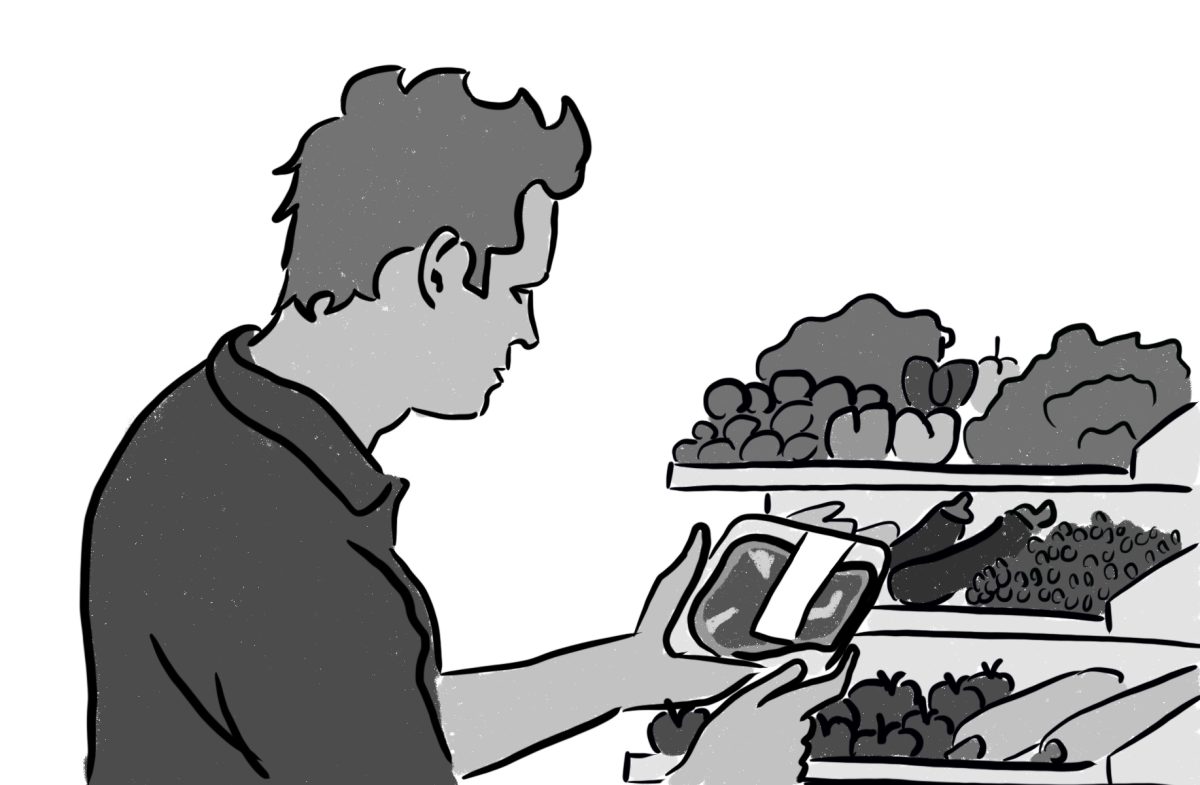
On the week of April 19th-26th, the Environmental interest house (also called the Outhouse) celebrated Earth Day by putting on a vegan week, urging students to try out an animal product-free diet.
As a member of the Outhouse, I started the week excited to do my part — and ended it eating butter tofu from Cleve in the Outhouse dining room after doing a few Cleve laps and feeling like eating another salad or impossible burger would make me want to cry.
This adventure opened my eyes to what it would be like to be vegan, especially as a student on a meal plan. And while Cleve certainly is accessible to vegan people, there were times when it was frustrating — like when the Earth Day burgers that I was sure would at least be vegetarian were filled with beef. I was interested to see what perspectives Whitman students have on veganism.
Sophomore Cole Rolland-LeTourneau has been vegan for three years, having been vegetarian for years prior.
“I’m vegan for the same reason I don’t eat dogs,” he said. “Not because eating dogs is bad for the environment or because it’s bad for your health, but just because I think it’s wrong to eat dogs when we don’t have to.”
Rolland-LeTourneau said that learning more about the cruelty of the dairy industry inspired him to be vegan. He said that because cows must have recently had a kid to produce milk, they are forcibly impregnated, and their kid is taken away from them soon after it is born to keep it from drinking its mother’s milk.
He added that this kind of cruelty can’t be justified with reasoning like culture or tradition.
“People say, ‘it’s part of my culture to eat animals,’ but I don’t think [culture] is a good reason to cause harm or to kill anyone. We can think about other cultures where people are enslaved or mutilated, and just because it’s their culture doesn’t make it okay,” Rolland-LeTourneau said.
Sophomore Freja Holmes grew up on a farm, where her family cultivated most of the animal products they consumed. For Holmes, eating meat is a full-circle moment.
“It’s never easy to eat an animal that you raise, but at the same time, I know that that animal has [had] a really good life… I was raised knowing meat not as something that you avoid, but something that you honor,” Holmes said.
She added that the proximity to the animals she experienced on the farm helped her make conscious choices about her food.
“We’re so separated from the food that we eat … It’s about tak[ing] that extra step to make a connection of where the products you’re consuming are coming from, whether that be food or something else,” Holmes said.
“I can still make an environmental impact while not being vegan,” said Holmes, “and I can still care about animals. I can still have a stake in their lives. They can have a stake in my life. We give [animal] products and food and supplies to the people that we love, and those sheep are extending their energy to the people that we love, and when they’re alive, [they] get to run around wherever they want, and they have a huge barn, and they have food all the time, and they’re really spoiled. So I feel comfortable eating lamb from my farm because I know that, [as] we say, ‘they have one bad day,’ which is when they’re killed and processed.”
That connection is one way to make a meaningful impact on the environment, and sometimes also for animal rights. Veganism is often pushed as a sole solution to environmental and animal rights issues, but there is more to consider when thinking about the effect we can make with our actions.
Highlighting this, sophomore Taylor Pyle said, “A lot of people who think [everyone] should go one hundred percent vegan aren’t considering other forms of taking care of the environment. They’re so focused on veganism being the way. Someone might be focused on using renewable energy or something else that [works for their lifestyle].”
Sophomore Caroline Gorham Siegler explained why veganism is not always accessible, and why it consequently might not always be the right choice.
“There’s [so many] drawbacks to being vegan — it might not be the healthiest for some people. It might be more processed foods, or it might just be too much thinking about food. It might be more expensive. Making [veganism] fit to your lifestyle has an impact on so many [levels],” Gorham Siegler said.
Holmes said that as a college student, she could imagine veganism being difficult for financial reasons.
“I rely on Cleve for food. I only have a certain amount of products at Cleve that I can choose from, so choosing vegan is sometimes really difficult. It is more of a limitation on what I [can] eat than I want… Sometimes you just have to take what you’re given, and it’s not always vegan — actually, rarely [is it] vegan. If food is provided for me, I’m going to take it. Not everybody has the privilege of pocket money to go buy tofu or soy milk or something from Safeway,” Holmes said.
Highlighting this lack of accessibility, Gorham Siegler added that while she understands the intentions of those who are vegan, that same reasoning does not work for everyone.
“Their reasoning is a lot of the time about the environmental impact or about the impact on animals,” she said. “I think that’s all valid … [It’s] terrific that that works for [their] lifestyle, but for some people, it’s not going to be conducive to how they live.” For example, she said, they may not have “the time to plan out what they’re eating. [When thinking about] movement toward a more sustainable future, and a more vegan-focused future, there’s going to be a lot less people willing to go vegan if the requirement is to be all or nothing.”
Holmes added that highly restrictive diets can be problematic, especially for young adults. While veganism is often categorized as a form of activism rather than a method of restriction, it ties into diet culture in a way that can be detrimental.
“Veganism and that kind of dietary restriction is heavily intertwined with diet culture,” she said. “[I come from] an all-girls private high school, so conversations [about] food were a really big thing. It was on everybody’s mind. Everybody wanted to be skinny. Everybody wanted to be pretty. We [were] all comparing each other all the time. The idea of veganism and vegetarianism was brought up in that conversation because a lot of people also [heard a lot] of the ‘health freak’ [messaging],” said Holmes. “There were huge conversations about cutting out butter for the sake of getting a flat stomach.”
She said that despite the common perception that a vegan diet is a healthy one, the reality is more complex than that.
“I might thrive on fish and those omega-3 acids and you might thrive on the iron in meat. What is going to fuel my body is not going to fuel your body in the same [way] … Some people do not get the nutrition they need from eating vegan. It’s actually more harmful for them … There are only so many beans you can eat,” Holmes said.
Pyle added to this, emphasizing the consequences of the way we tend to think about veganism.
“I think we should focus less on all-or-nothing veganism. Especially because all-or-nothing thinking is really common in eating disorders. [You can] try to go vegan, but if it’s [your] best friend’s birthday and they’re having a cake and you want to celebrate, that’s okay too,” Pyle said.
Rolland-LeTourneau agreed that veganism doesn’t look the same for everyone.
“I think what people don’t realize is that being vegan is avoiding the use of animals and animal products as much as [is] possible for you. So everybody can be vegan if they avoid it as much as possible,” Rolland-LeTourneau said. “[But] even if you try your hardest and maybe you mess up sometimes and can’t be fully vegan, if you’re just aiming to be fully vegan, then that’s better than [nothing].”
However, he added that a mere reduction in the animal products we consume as a society isn’t enough.
“Vegan[ism] should be the end goal,” he said, “because if [our] goal is just to reduce, then we’re never going to get to a world where we don’t exploit animals … even if you’re only eating a little bit of meat, the animal is [still] a little bit dead.”
“I like to take into consideration both animals’ perspectives and humans’,” he said. “Ask yourself, would I rather be a pig who is gassed to death at six months old, or would I rather be a person who has to live without bacon?”
Whitman students had a wide range of views on veganism, and it is clear that it has lots of benefits for the environment and animal rights, but also comes with drawbacks like cost and mental strain. As we work toward a more conscious future, it is important to consider things like where our food is coming from and the process that it takes to get our food onto our plate, but also to think about other ways we can support the issues we care about.