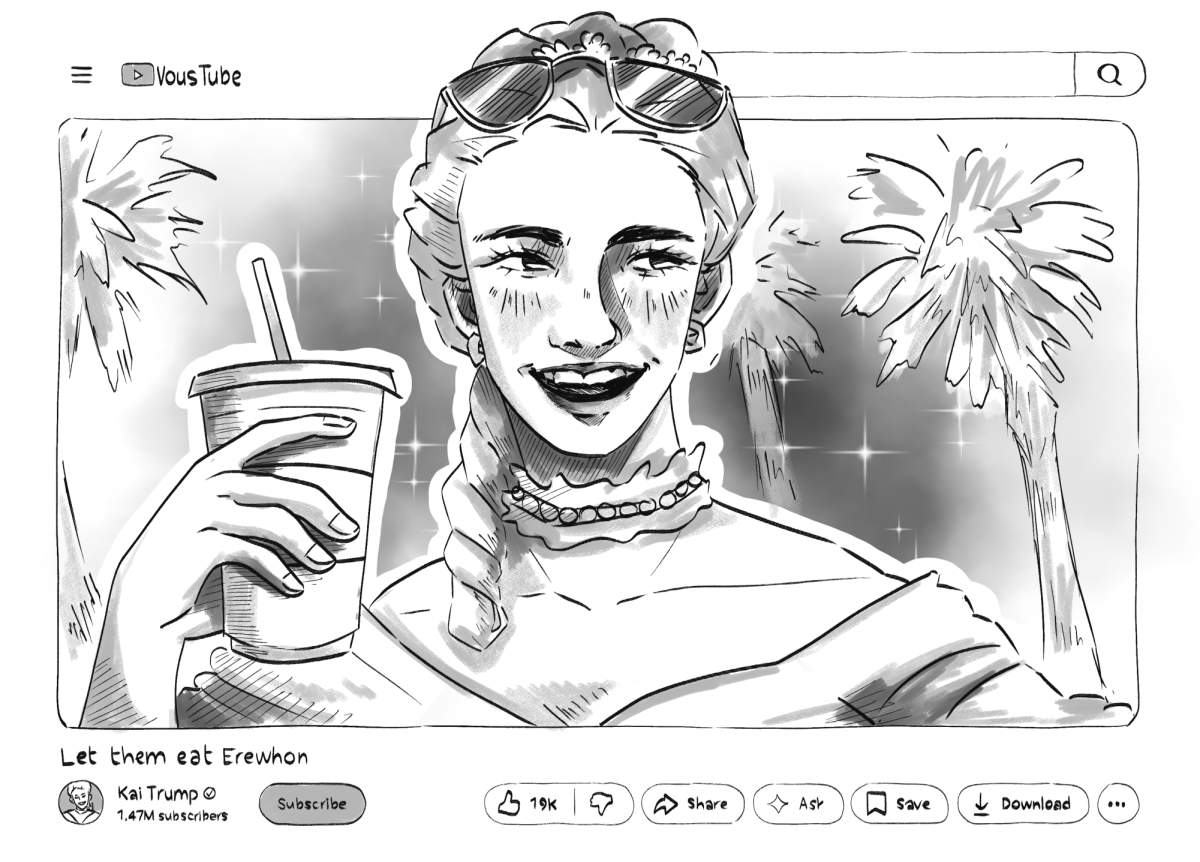
“I Took My Secret Service to Erewhon!” is the title of Donald Trump’s eldest granddaughter Kai Trump’s YouTube video, which she posted on March 8, 2026.
An alleged “social media influencer,” Kai Trump uses her YouTube platform to post videos about her life, including trips and golfing excursions, frequently featuring her grandfather.
This video has received backlash from the public, with many labeling it the “let them eat cake” revitalization of our generation. Kai Trump is not the first “influencer” to commit an act the public sees as “out of touch with reality,” so why has this video struck such a nerve?
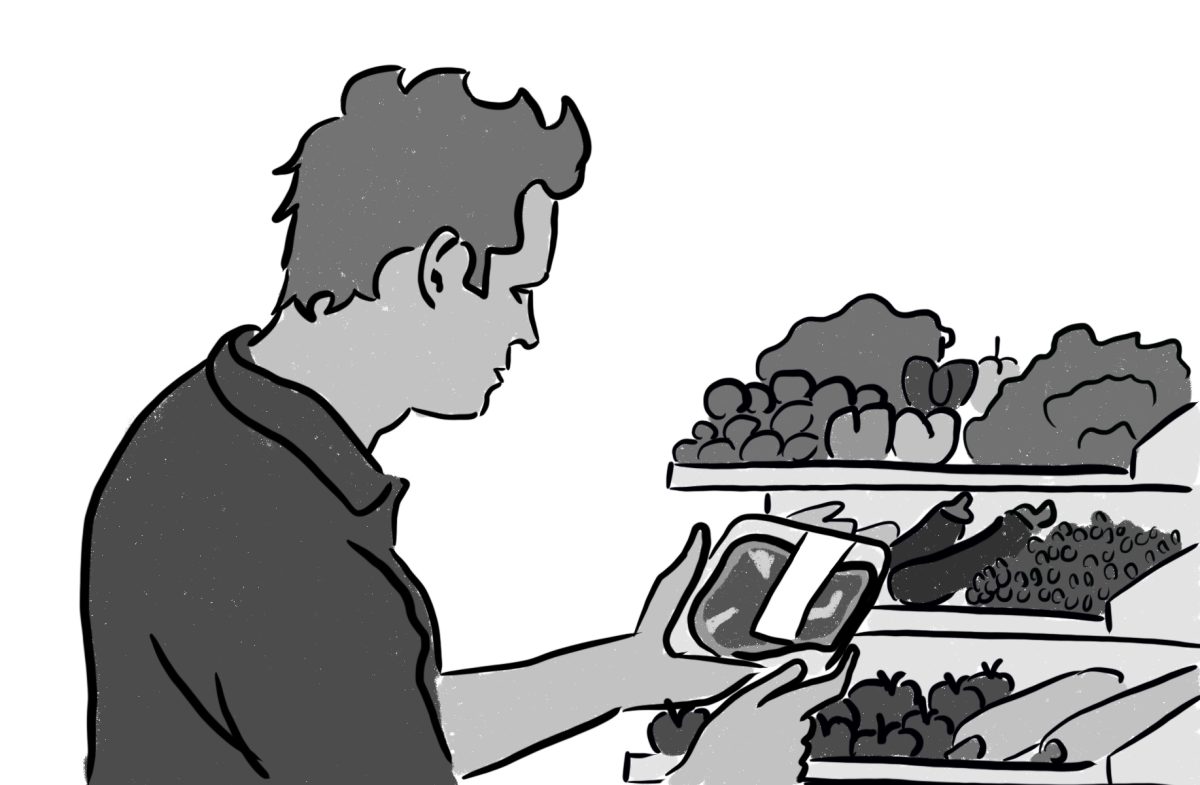
In our current economic climate, we’re facing almost record-breaking gas prices, food price inflation and changes to SNAP benefits.
In contrast, Erewhon is an upscale, Los Angeles–based grocery store that sells food, wellness items and merch (for those able to spend $50 on a jar of turkey chili).
Rising to fame in the past couple of years, Erewhon has grown to become a status symbol for the wealthy and health-conscious. Located in the heart of Los Angeles, many celebrities have contributed to Erewhon’s fame, including Hailey Bieber, who partnered with Erewhon to create the infamous $20 Strawberry Glaze Skin Smoothie.
Many comments on Kai’s video angrily accused the young Trump of being “tone deaf.”
“let them eat cake but actually”
3.8k likes
“Straight up Hunger Games at this point lmao.”
7.4k likes
“I love that my taxes are funding this instead of school lunches.”
10k likes
I talked with Professor Jenna Terry, Senior Lecturer of RWPD and General Studies, about her thoughts on Kai Trump’s video and its surrounding discourse.
Q: What is your job title/specialization?
A: My speciality is in writing although my background includes a lot of visual and film rhetoric as well as organizational rhetoric, which means companies and institutions.
Q: What are your initial thoughts about the Kai Trump video?
A: It feels like a pinnacle of privilege to buy things from what she calls the most expensive store in LA, for kicks. That feels incredibly divorced from the lived experience of pretty much anybody I know or would prefer to imagine. When you look for just the video, commentary about it pops up — and I saw comparisons to the [historical phrase], “let them eat cake,” which, having watched it, I can understand where that comes from… One of the things I notice is how she arranges the video. I am assuming that she either does her own editing or, at the very least, has somebody who helps her edit. So I’m thinking not just about the immediate moment that happens in the video and what she’s doing, but also about how it is presented to us… We could spend the entire time looking at the framing. Look at her makeup, look at her sunglasses, her hair, the earrings, the perspective that almost makes it look like a classical painting – and yet it’s also very much a portrait of her.
Q: Why do you think the public is so angry about this video?
A: We’re not in a moment where things are financially easy for the majority of people, either nationally or at this college, in terms of staff and faculty. And it is easy — and justifiable — to get angry when you are struggling and others flaunt their lack of struggle, right? There’s a level of utter disregard in spending money for the sole purpose of spending money, and most people cannot afford that mentality. One, I could see that making people angry. And two, what she then does with the things that she spends money on — she’s like, ‘oh, this is the worst sushi I’ve ever had,’ and she throws it away and says something along the lines of no one should have to experience what I’ve just experienced. There’s a level of tone deafness there that really shows an utter divorce between who she is, where she is, the life that she leads and the lives of the majority of people.
Q: What are your thoughts on the “let them eat cake” comparisons people are making?
A: In terms of ‘let them eat cake’ as a symbol of disjunction of experience and knowledge between people who are uber-rich and people who are normies, it certainly works. And I guess this would have been an aspect of the reference. We can connect it to, ‘No Kings’ as a protest against her family. Part of why she has the role she has, part of why she’s able to do this, is not just money — it’s connection to Trump. It’s trading on the Trump name. And so that is an effect: the dissociated royalty that we now have operating in an entirely different realm while the rest of us try to have lives of meaning and value. I can understand that connection being made, and I think that those kinds of references can be really helpful for people. ‘Let them eat cake’ is such a nice, pithy saying. That’s part of why it has persevered, right? That’s part of why we still know it and still use it. Even people who have no idea what it’s in reference to have some understanding of what it actually means.
Q: How do you view recent rhetoric in politics?
A: I, like many people, feel a combination of disgust and sadness and fury and hopelessness at our current political situation. So that’s just kind of a precursor. And when we get to language and how language is used, I look at who some of our leaders are and mourn how language is used. Whether it’s “bombing the F out of a civilization,” as was said on Easter Sunday, there is a degradation to language in that, as well as a degradation to history and humanity and humaneness that gets echoed in the language. It’s not just “we’re going to bomb the civilization,” it’s the “effing.” It’s the idea that anybody should be talking about taking out a civilization. Are you kidding? That is degradation in every field. It is very hard as a human being not to feel hopeless and despairing about what that means for how humans exist… Part of what we are calling the rhetoric of the political moment is a deliberate attempt to overwhelm and to awe-strike so that there’s no response. That happens at the larger level, at the national level. And it happens at our college.
Q: What would you say to students who are upset about current things going on in politics or who are upset with this video?
A: There’s a reason that despots go after education first, because that is the route toward change and toward correction. I really do believe that education is the only solution we have to restore a sense of shared humanity, true knowledge, understanding, humaneness, etc. By choosing to be educated, by choosing a route that really is quite difficult—educating yourself is not easy, this is not a guaranteed route toward happiness—I do have a weird amount of hope for people of your generation. I’m sorry, but I get to say that because my kids are your generation. Some of these people who have made these changes are dead and dying and on their way out… I really do have a lot of hope that people are still choosing education. It’s very powerful.
Q: Final thoughts?
A: If we don’t know how to analyze, we don’t know how to think. We lose our ability to understand the world in which we’re living. We lose our ability to have meaningful connections with other people, to have meaningful impacts in the world. Whatever your politics, I think that holds true. So I will maintain that close reading and analysis — whether that’s of a video or a monument or a sign or a person’s face — that is one of the most powerful activities one can practice to understand the world in which they are.
———————————————————————————————————————
The response to Kai Trump’s video reflects how rhetoric and media shape our views of the world, and how one video can perpetuate and hold significant power. Viewing it as a rhetorician allows us to see the small details that lead people to make connections or contrasts to their own lives and act accordingly. I encourage you to view the next piece of media you see through the eye of a rhetorician, and remember that every word and image holds meaning.