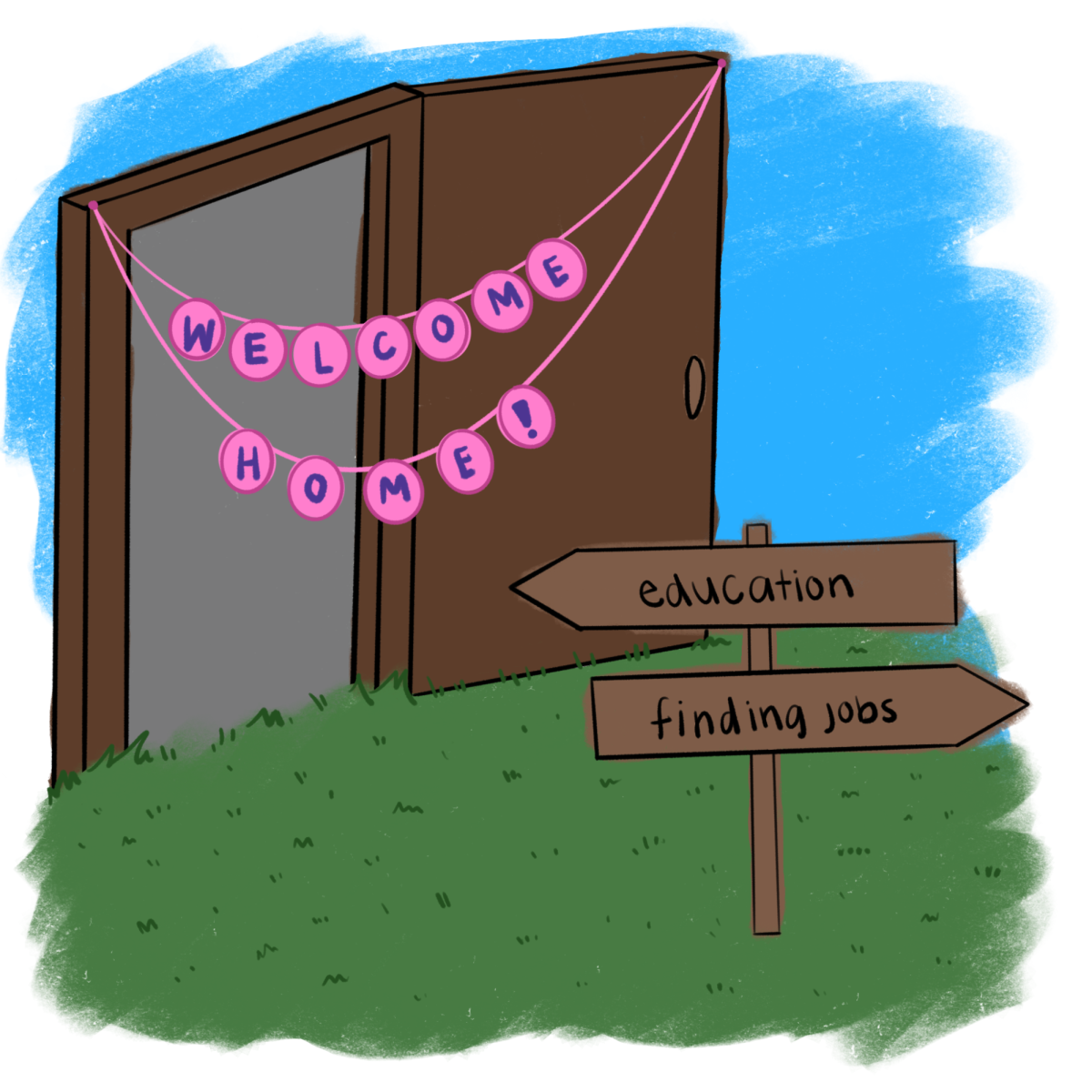
As a small liberal arts college, Whitman prides itself on bringing together diverse backgrounds and perspectives. For religious students at Whitman, its secular nature is both a benefit and drawback. It sparks conversations across divides, but limits resources and representation. Some colleges and universities, on the other hand, are affiliated with a specific religion, which can create a strong community with lots of room for personal growth, but limits opportunities for interaction across belief systems. I talked to three students that are involved in religious groups at Whitman to give readers a better idea of what it means to practice faith here.
Sydney Sohn is a sophomore at Whitman and a member of Kehilat Shalom, a group for Jewish students on campus. Their main event, she said, is “Fridays at Five,” where students gather to celebrate Shabbat.
“It’s a great way to anchor my week … and connect with people who share the same beliefs as me,” Sohn said.
Deo Rubangakene ‘28 and Emily De La Cruz Hofer ‘26 are both members of Whitman’s chapter of the Intervarsity Christian Fellowship. This group meets weekly in the All Faiths Room for Bible study, where they read and discuss scripture. Each week, the discussion is connected to a different theme — the week I talked to Rubangakene, the theme was justice.
Describing religious groups on campus, Rubangakene explained that they are meant to be inclusive to all students, no matter their experience with religion.
“In the past,” Rubangakene said, “these groups [were] just for people that were of [a certain] religious affiliation before they came to the college. But when you look at college, it’s a time [for] exploring a lot of different things, including religion. These groups are supposed to be spaces where people can go to ask questions and meet people that could answer [them]. They are meant to be a resource for students [who are] either practicing the faith, exploring the faith or just simply curious about the idea of the faith.”
This emphasis on inclusivity has allowed these groups to create strong communities for students. Sohn highlighted how Kehilat Shalom has become a positive community for her.
“I at first didn’t join Kehilat Shalom, but I felt like the religious part of my life was missing. When I first decided to come to a Shabbat, it felt so much like a home to me, and I felt like, despite the fact that I didn’t know a lot of these people, I could connect with them, because we had this shared faith and Jewish heritage. It instantly became a place where I felt like I could belong,” Sohn said.
De La Cruz Hofer mentioned this as well when discussing Intervarsity.
“It helps me feel less alone in my faith,” she said. “[Without it], I would definitely feel a lot more isolated and I don’t think I’d be where I am right now. I would probably have some community connections, but mostly older adults. It’s entirely different connecting with people your own age.”
Religious-affiliated schools also offer opportunities for building community around religion, and I was curious whether Whitman students felt like they were missing out on that. Rubangakene said that while those schools have much more emphasis on religion, that doesn’t mean it doesn’t exist here.
“It is no lie that Whitman is a very secular [college], but that does not mean that there are less people that believe in some sort of God or follow some religion,” said Rubangakene. “[At religious affiliated schools] there [are] designated support systems. But I also think it’s beautiful to practice your religion in a place like Whitman … If you go to an institution that [follows] just one faith, it kind of narrows down your exploration. You only go there if you’re in a certain position in your journey,” Rubangakene said. “ [But at Whitman], we have people from across the world, across the country and across religious divides. [Interacting with others of different faiths], you challenge your own biases.”
Sohn added that in addition to being able to interact with students across religions, Whitman offers a unique opportunity to build meaningful relationships.
“I didn’t want to specifically go to a Jewish-affiliated school,” Sohn said. “A lot of other schools have larger Jewish communities. And I think a lot of times people associate size with strength, but I really think that [because of] the fact that our Jewish community here at Whitman is so small, we are so much more interconnected and stronger.”
For De La Cruz Hofer, attending a secular school helps her connect more deeply with her faith.
“[At a Catholic school], I feel like there would have been more opportunities to grow in my faith, but at the same time, I feel like I would not have as much opportunity to engage with the secular world, to have spiritual conversations with people outside of my faith,” De La Cruz Hofer said. “[Those conversations] motivate me to get to know my own faith better — people outside of Catholicism ask a lot of really good questions that a lot of [Catholic people] do not think of.”
However, being a religious student at Whitman does pose challenges. For Sohn, representation is vital in order to feel comfortable and supported in her faith, and Jewish representation at Whitman is limited.
“There is a solid Jewish student representation, but less so in the faculty and staff. In particular, our club advisor was recently laid off because of budget cuts. It’s really difficult when you don’t see that representation … It makes [Judaism] something that’s talked about less in classes,” Sohn said.
Having more representation in the faculty and staff would not only allow for more conversations about Judaism, but provide role models for Jewish students.
“[It’s beneficial] to have someone who’s lived longer than you, who’s in the same community [as you],” Sohn said. “The knowledge that someone else feels comfortable in this community because of their religion helps[s] me feel more comfortable.”
Sohn grew up in Los Angeles — a place with a large Jewish population. Coming to Whitman, she said, changed her idea of the importance of representation.
“I never thought about how much representation mattered, regarding Judaism, until I came here. I think I didn’t think about how many people in my community were Jewish … going from somewhere where it was just so much of the population to so little, I think it shows the importance of not only being confident and proud of your Judaism, but having people you know you could go to if you needed to talk,” Sohn said. “For example, our advisor is someone I know I can always talk to — whether it’s navigating my political views relating to religion or just things going on with people with my religion around the world.”
“It can feel a little bit isolating,” Sohn said, “to [only be around] people who aren’t going through the same experiences that you are. For example, when there’s targeting of Jews in other places, it can feel very scary, and [it is helpful] to have other people who have that same knowledge and shared understanding.”
For Rubangakene, a lack of open discussion of religion at Whitman has been harmful by creating stereotypes and assumptions regarding religious students.
“Religious practice,” Rubangakene said, “is an individual endeavor. How I practice my faith could be different from the next Christian. But the media, the history, the books and the stereotypes, make us form this blanket assumption about everyone … I think that’s disastrous as an assumption.”
Those assumptions can be detrimental when students become afraid to express themselves due to fear of being “put into a box,” as Rubangakene put it.
“People love celebrating Easter, but no one will want to come to an [Easter] event,” Rubangakene said, because people will fear being put into that box.
Rubangakene said this is something Intervarsity considers when planning events — will people avoid the event out of fear of being judged? Additionally, he added that despite Whitman’s promise to field discussions across perspectives, religion is often seen as taboo.
“People can talk about anything on Whitman’s campus, but when you bring religion into the conversation it almost feels like an attack, even when you’re just trying to present a part of your identity … [For some] people, that’s the only resemblance of home that they have and talking about it makes them feel at home. But we don’t have [enough] spaces to talk about it,” Rubangakene said.
“The histories of religious practices have made it a very touchy topic,” Rubangakene said. “People get volatile when you talk about religion … The idea invokes a lot of fear. But I think we should talk about religion as openly as we talk about anything else.”
De La Cruz Hofer added that she is sometimes nervous to talk about her religion because of how others might perceive it.
“If we do try to talk about our faith, we’re not trying to convert [anyone]. We’re just trying to share ourselves. It helps to give people a clearer picture of who [we are],” De La Cruz Hofer said.
In addition to advocating for more dialogue, Rubangakene also highlighted the importance of support systems on campus.
“If you need counseling, you can go to Welty, but they never talk about [where to go] if you need spiritual guidance … The only mention of religion in our syllabuses is if you need religious accommodations, but how do you know you need that?” Rubangakene said. “Let’s say you’ve started just exploring a faith. You don’t even know the holidays. You need a support system.”
Ultimately, all three students emphasized that all religious groups on campus are welcoming and inclusive to all students.
“It can be very daunting [to try to find a religious community],” Rubangakene said. “You can feel like there’s no one else that shares [your] faith, but there are so many people at the college that would be able to sit down and talk about it … If you need that community, it will always be there.”
“Whitman students who have some sort of religious identity or heritage that they feel somewhat strongly about should get involved in a group that represents that. Even if it’s a religion or part of their heritage they want to explore further, I would really suggest that they do it. It’s felt like a grounding thing for me, and it’s only enhanced my college experience — there have been no downsides to joining this community,” Sohn said.
Beyond these groups, there is also a Muslim Student Association where students can gather for meetings and events. Whitman has lots of benefits for religious students, from building community to sparking conversation across groups, but also lots of room for growth. Increasing representation, creating more spaces for dialogue and adopting a curious rather than judgmental mindset will be positive changes for students practicing religion here.