Imagine you’re waiting in line at a checkout counter and the person in front of you is struggling to pay for their groceries. They can’t seem to understand how tap to pay works. They’re 30-something, so surely they should know how such a common practice is used. You get frustrated with them — how hard can it really be?
But what you don’t know is that they’ve recently been released after being incarcerated, where there was no such thing as tap to pay. This is just one of the things that comes up during the transition out of prison. It’s something that often goes unacknowledged, but is a simple thing that impacts the difficulty with which one goes through their day-to-day life.
Societal and cultural changes like this one, along with the need for housing, employment, mental health treatment and more, are examples of why formerly incarcerated people need to be met with empathy and support.
Anthony Covert ‘29 is a formerly incarcerated student at Whitman. He said that community support was essential when transitioning from incarceration to life as a student.
“One of the biggest things that supported me coming out here was knowing that I’m not alone,” he said. “When I first came to this campus, I had imposter syndrome: ‘Man, how am I gonna relate to, in my head, kids?’ But then I had to transition my thinking. You’re students. I’m a student. We’re the same. There isn’t a hierarchical thing, this age thing doesn’t matter. We’re in the same classes learning the same stuff. We’re on the same journey trying to get to the same outcome — to graduate.”
“[At Whitman,] I’m being seen as the person that I am and I’m being literally met where I’m at. There is encouragement, there isn’t alienation,” Covert said.
The act of repeating an offense after receiving punishment is called recidivism. Covert said that recidivism happens when people come back into our communities and the community doesn’t receive them.
One way to increase this kind of community reception is through employment. Washington State Penitentiary volunteer and Whitman senior Zachary Peterson highlighted this.
“Reentry is multi-variate and unique to each person,” Peterson said. “However, one aspect of reentry I find [is] often overlooked is the economic pressures of leaving incarceration and the ways said pressures contribute to recidivism.”
Despite the difficulty that comes with acquiring a job after incarceration, it can often be extremely beneficial not only for an individual by providing routine and economic security, but also for the employer.
“I guarantee you,” Covert said, “some of your best workers are gonna be previously incarcerated people, because all we want to do is come home and be a member of society. But when society doesn’t allow for us to be a member, we become the outlier… Don’t let us be outliers. Let us be a part of the scatter plot. Let us be a part of the main functionality of society. Don’t exclude us.”
One Walla Walla program that aims to assist formerly incarcerated folks in finding jobs, among other things, is the Successful Transition and Reentry (STAR) Project.
Chris Wakefield, Whitman professor of sociology and member of the STAR project team, spoke to the mission of the STAR Project.
“The STAR Project is a restorative justice-based organization whose primary role is in serving individuals who have been justice impacted,” Wakefield said.
One type of programming that helps them reach this goal is providing housing. The STAR Project has two houses in town for people to rent, one for men and one for women. Wakefield explained why this housing is important.
“In an era where background checks for rentals are increasingly common and a felony conviction on that background check could mean that you’re not getting to rent a house or an apartment altogether, the STAR project is the only guaranteed place where someone could absolutely get accepted for that housing,” Wakefield said.
Further, the program assists folks with adjustment to changes in culture and routine.
“If you’ve been in prison for 20 years,” Wakefield said, “you may have never owned a smartphone. You may have never applied for a job online. You may never have had access to social media before. You may never have seen a credit card reader that has tap to pay and you may not know what tap to pay means. So how are you supposed to navigate even the most basic of tasks?”
The STAR program aims to help people work through those challenges. One participant of the STAR program, Jason Brickman, was interviewed for the program’s website.
“I’ve been coming to STAR for eight or nine months now,” Brickman said, “and these people have shown me nothing but love and encouragement…I’m now 11 months clean, sober and trouble-free.”
STAR helped Brickman get involved in community service, which has been beneficial to him.
“I now do stuff today that makes me feel good about myself tomorrow. And I think that’s what giving back is all about,” Brickman said.
However, Covert emphasized that the path to reentry is different for every person, and for him, it was important to have independence rather than close support.
“A lot of people coming out of prison need a lot of assistance. They need to understand how to write a resume, how to be able to conduct themselves in public. I was not one of those individuals. I [did] work inside to prepare for my reentry,” Covert said.
While participating in the STAR program, Covert said, “I felt like a lot of that [preparedness] wasn’t seen. I’ve never been a person that used drugs… [I was] told that because I’m a part of this program, I have to go to drug and alcohol treatment classes, narcotics anonymous treatment classes and all these things. Why am I taking up space for someone else that might need this space?”
“Let’s make sure we’re meeting people where they’re at,” he said, “seeing people for who they are and not for what they’ve done.”
Covert said that one positive example of this was with his community corrections officer (CCO). After being released, individuals experience a probationary period where guidelines are enforced by a CCO. He said that unlike most, his CCO allowed him to have independence, which was very impactful to his successful reentry.
“I’m fortunate enough to have a CCO who allowed me to be able to thrive in the community… Two weeks out of prison, I got to go to California [and be a] part of a seminar out there that was transformative, that taught you how to be on a higher frequency of thinking and learning. He let me do that, and I wish that every CCO would be willing to do that with their client, if applicable, because everybody has to be met where they’re at.”
As a community, we also have the power to help those going through reentry.
“We can choose to more directly participate in that process,” Wakefield said. “One of the things that I think is a big mistake in the mindset regarding people reentering is that they assume that it’s something like the STAR Project’s responsibility to do this labor of reintegrating someone, that it’s somebody’s job somewhere to help this person. I think a more restorative justice mindset says that…the whole community is responsible for reintegrating individuals that we’ve incarcerated. All of us [should] take responsibility for the folks who return to our communities.”
“Here in America,” Wakefield said, “it’s a very unpopular position. We really don’t like the idea that we are supposed to help people who once harmed us… but if we would like to have a healthy community, if we would like to have a community where mistakes don’t doom you forever, then that means we all collectively have to take some level of responsibility for helping someone reenter successfully. That means taking the time to explain to someone in the grocery store what tap to pay means. That means getting to know and welcoming people as they move in, treating them like a neighbor that you would want to have, not someone to fear.”
In addition to community support, Covert said one thing that helps folks like him prepare for reentry after incarceration is the Black Prisoners’ Caucus, which is a long-standing program that aims to create advantages for people of color coming in or out of prison.
Covert, who is involved in the program, said, “We have a program called TEACH, or Taking Education and Creating History, [where] we work with many schools, counties and educational professors to be able to get people some type of education while being inside. We teach a multitude of different types of classes.”
Washington State prisons are very limited in educational programs. While basic courses are sometimes available, they are often only accessible for certain groups of people. And since 1995, Washington state law has prohibited public funding supporting prisoners’ higher education.
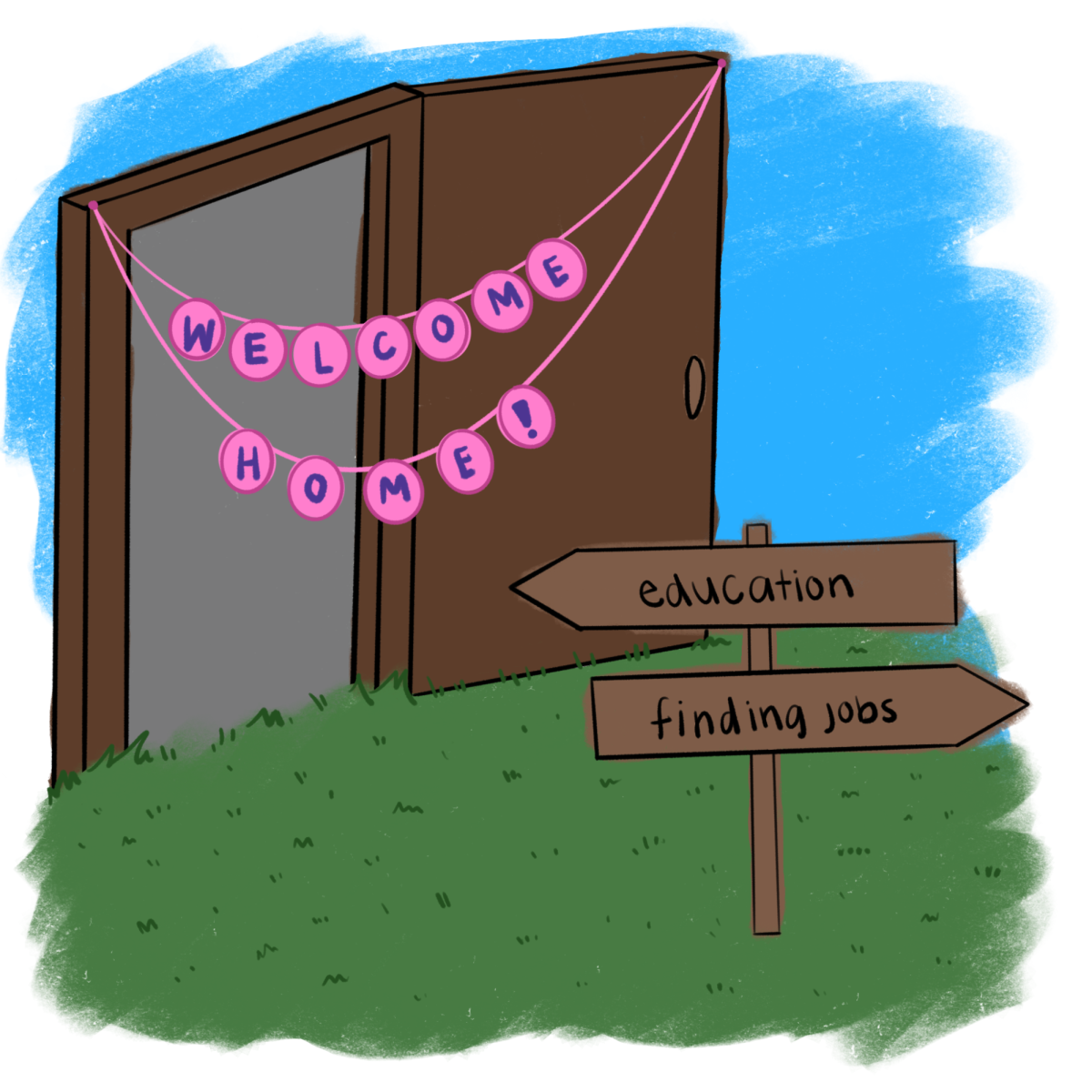
Programs like TEACH can be helpful for incarcerated people by providing education necessary to succeed outside of prison. Reentry is about more than finding housing and a job after release, but building a foundation, through education and community engagement, that sets you up for success. Ultimately, with awareness and empathy, we as a community can make the path to reentry a little easier to travel.