On Dec. 3, the Southeast Washington Ski Area Bluewood announced it would postpone its projected Dec. 6 opening day due to insufficient snowfall. The news was not particularly shocking. Bluewood has historically opened between the middle and later weeks of December. However, the area’s latest weather conditions indicate that this year’s limiting factor is not a lack of precipitation but relatively unseasonably warm temperatures for its elevation.
Bluewood is not unique in these conditions; winter recreation areas across the Pacific Northwest and the Inland Northwest have experienced challenging starts to their winters. Whitman Senior Ian McClelland reported that the ski resort he grew up visiting, Schweitzer, is experiencing similar early-season conditions.
“Usually it’s got pretty good snow, but this year specifically, they were getting precipitation 80% of the days,” said McClelland. “They were supposed to open a week and a half ago, and there was not a single inch of snow on the mountain because it had been too warm and [was] just raining.”
According to the Washington State Climate Office, La Niña events in the Pacific Ocean are projected to increase precipitation and cool temperatures this season. Still, snowpack is not expected to increase statewide. The conditions have prompted some outdoor recreationalists to wonder how winters will change as the climate warms. Snowfall is not a thing of the past. This region has experienced abundant snowfall in recent years, but the warm, wet start to this winter is consistent with recent climatic trends.
“Since the mid-1950s through 2006, we have seen approximately a 15 to 35% decline in snowpack in Washington state as a whole,” said Jacob Genuise, Engagement Climatologist with the Washington State Climate Office.
Historical statistics are based on data collected via SNOTEL, a network of automated sensors deployed throughout the Western US that measure snow depth and snow water equivalent. The Natural Resources Conservation Service, an agency within the U.S. Department of Agriculture, operates these sensors. Some have been collecting data for decades, with the earliest sensors being installed in the 1970s. From a water-supply perspective, both metrics are essential. Snow depth is a reliable indicator of accumulated precipitation; however, two areas with the same snow depth can differ in the volume of melt they produce because of snow water equivalent, the water content of a given amount of snow. Temperature is one of several factors that influence snow water equivalency, with lower temperatures often resulting in lighter, less dense snow. Wind speed during snowfall is also a factor; higher speeds often result in more compacted snow and a higher snow water equivalent. Time also plays a role, since gravity compacts snow over time. When areas that used to remain consistently below freezing during the winter months experience more frequent temperature fluctuations above freezing, there is less time for gravity to compact snowpack, which can result in a lower snow water equivalent.
Genuise also reported that by the 2080s, statewide snowpack is expected to decline by 17-83%. The decline in snowpack varies widely with the rate of temperature increase and emissions. The numbers have been calculated using climate models under different future scenarios or shared socioeconomic pathways.
Loss of snowpack is evident primarily in alpine areas, but its effects are felt across the region. These effects can be highly consequential for residents of the Northwest US.
“There’s flooding, and there’s drought, two sides of the same coin,” Genuise said. “Our flood risks are increasing because we’re getting more of this liquid precip that’s falling in a shorter amount of time.”
This issue has a notable impact in Walla Walla, which is already facing greater flood risk than other population centers since it was built within the Mill Creek Watershed. Mill Creek has historically been fed by snowmelt. It is the municipal water source for the city of Walla Walla and supplies local farmers with irrigation water.
“All of our agricultural communities, by and large, pull from water that melted out in May or June and then was caught in reservoirs. So if we’re seeing less melt out, that’s going to really have a big impact on farms and on municipal water use in Eastern Washington, especially,” said Genuise.
Higher elevation zones have been less affected by the loss of snowpack. This includes areas such as the Northern Cascades, whose average elevation exceeds 7,000 feet. Bluewood reaches a height of 5,670 feet at its highest point, several thousand feet above nearby population centers, but the Climate Office classifies it as of middle elevation.
“The middle and lower elevations are most at risk,” said Genuise. “They typically … receive snow right around freezing or just below. Any warming from climate change will significantly impact these areas. They’re just on the cusp of snow and rain, and any warming will push them into kind of a rain-dominant regime.”
According to local geologist Kevin Pogue, rising temperatures in the Pacific could increase winter snowfall, but only in higher-elevation zones.
“Warmer ocean temperatures can pump more moisture through evaporation into the atmosphere, which, if you’re already in a snowy situation, can give you bigger snowfalls,” said Pogue.
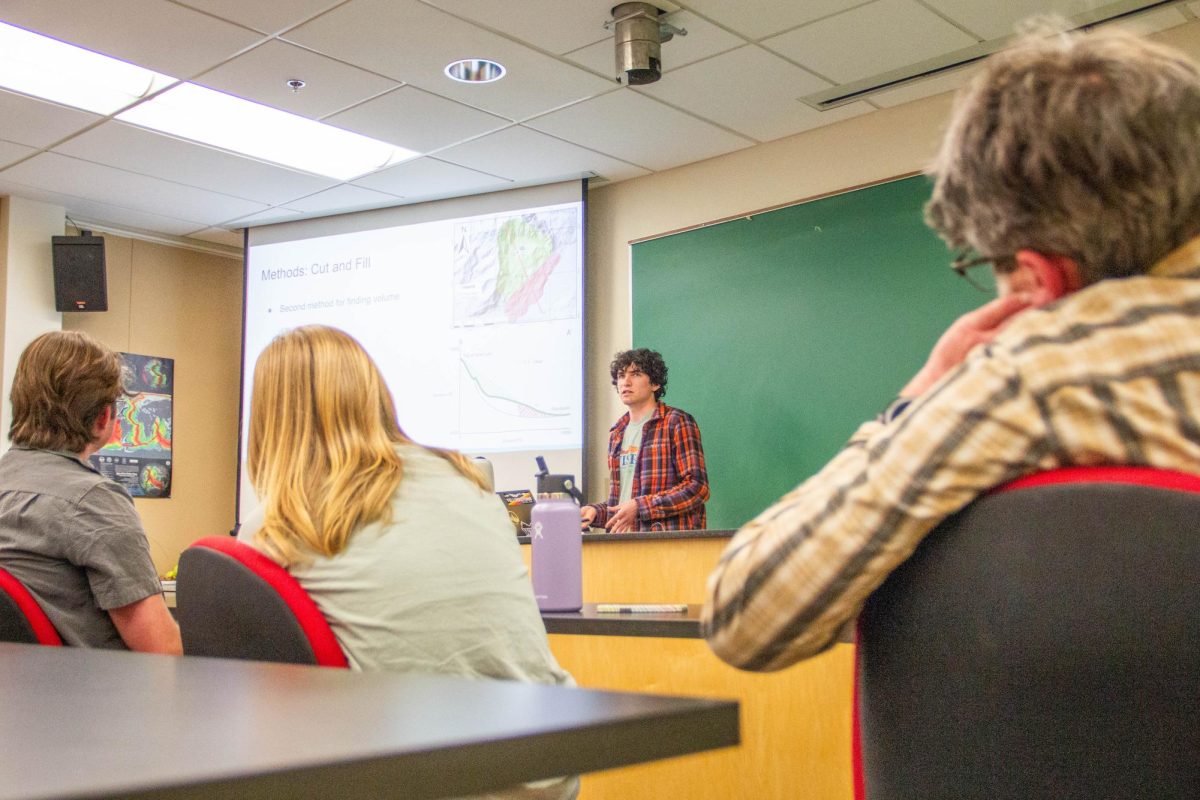
Pogue taught as a professor within Whitman’s geology department, but retired in 2024. Academically, he is well known for his studies on the topic of terroir – the intersection between a place’s geologic history and its agricultural potential. Before his retirement, he taught a course on weather and climate, a topic that often tied into his research. Based on his observations, the most evident effects of climate change at the local level are warmer morning lows, while afternoon highs have remained relatively constant.
“I did a study some time ago to figure out the best place to grow certain varieties of grapes. I looked into a whole bunch of weather stations, and was surprised that in the last 30 years or so, the number of average frost-free days at some of the higher elevations in Oregon and Southeast Washington has increased by as many as 20,” said Pogue.
Those findings have quite significant implications. Since early-morning frost often halts the growing season, more frost-free days indicate a longer growing season, which many farmers consider beneficial. On the other hand, this longer growing season is accompanied by shorter winters and reduced snowpack, which have made drought risk ever-present.
“The biggest effects of global climate change by far have been in the polar regions, which are warming much faster than anywhere else. It has the potential to affect everything because when the snowpack decreases, there’s less light reflected into space. It becomes a positive feedback loop to warm the whole planet,” said Pogue.
In good news for local winter recreationalists, Pogue is confident that snowy winters in the Blue Mountains aren’t going away just yet. During his time at Whitman, he has significantly impacted outdoor recreation opportunities and has observed local seasonal patterns for decades.
“[The OP has] been climbing frozen waterfalls up towards Bluewood,” said Pogue. “Every five or six years, we have some super cold year where the ice climbing is good, and it’s stayed that way. We haven’t had one in a while, but I haven’t noticed a big change in the frequency of that.”
In contrast, summer recreation opportunities have undergone significant changes due to climate change.
“I have noticed a big change in the frequency of how much forest fire smoke there is in the air here now in the summer times,” said Pogue. “It’s even affected our geology regional field trips. There have been two trips that we’ve changed at the last minute to avoid smoke.”
While wildfires are not a new phenomenon, the emergence of “smoke season” within late summer and early fall is a dangerously growing pattern. Climate change is just one of numerous contributing factors. Drought risk, fire suppression techniques from decades past and rising temperatures have significantly changed how local summers look and feel.
As global temperatures rise, climate scientists have made it clear that the seasons are projected to change. Adapting to imminent changes is crucial. This may involve minor adjustments such as altering one’s recreational habits up to larger social infrastructure shifts.