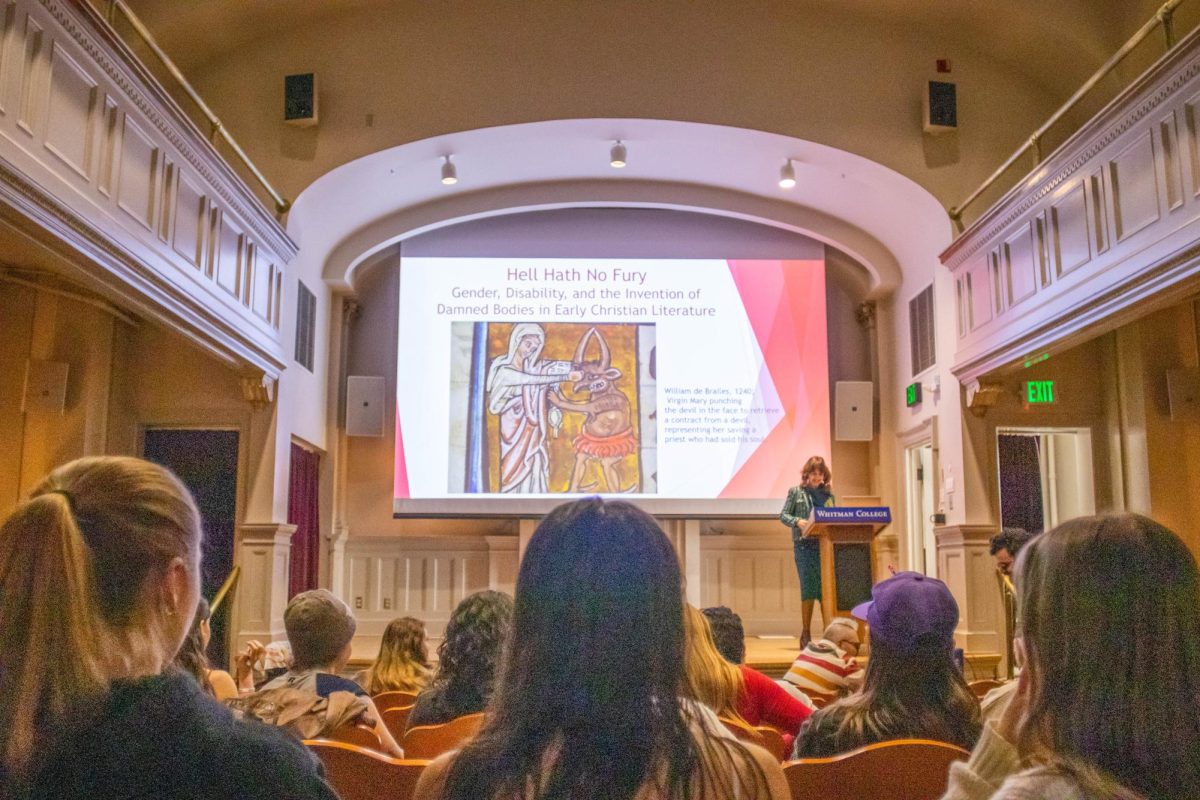
On April 22, Whitman community members gathered at Reid Campus Center to celebrate Earth Day and to hear from a panel of faculty and staff members as they addressed the college’s legacy of sustainability, encapsulated in a work titled Our Environmental Past: Reflecting on the Past and How We Move Forward.
The panel consisted of Senior Lecturer and Co-Chair of Environmental Studies Amy Molitor, Biology Professor Heidi Dobson, Chemistry Professor Frank Dunnivant, retired Geology Professor Bob Carson, Physics Professor Kurt Hoffman and Amy Brown, the new campus sustainability manager.
Aurora Ortega, a junior Environmental Studies-Biology major and Chair of the ASWC Sustainability Committee, organized the event to learn from soon-to-be-retired faculty about their collective knowledge of Whitman’s history before they leave campus.
“There’s so many folks on campus that are retiring that are essential to the Environmental Studies program and sustainability committees across campus,” Ortega said. “[These faculty] have just been a key part of enforcing environmental policies on campus.”
Ortega said that learning from faculty wisdom is critical to environmental and climate action work at Whitman, which is why panels like this are important.
“There’s so much knowledge that is lost in time. Especially with climate change getting worse, we can’t afford to lose any more knowledge that would help us in the future when we move towards more of our sustainability goals,” said Ortega.
Ortega specifically invited Bob Carson to sit on the panel because he has been instrumental in sustainable initiatives on campus. As a professor of Geology and Environmental Studies, Carson taught at Whitman from 1975 to 2015 and remains an active member in the school’s community. He sponsors the Bob Carson Outdoor Fund, which pays up to $150 for students to participate in Outdoor Program trips.
Dressed in an Earth Day shirt from 2000, Carson reflected on Whitman’s environmental work through the years, including when he co-chaired the school’s first Sustainability Committee.
“Environmental Studies was very strong in the early 70s,” Carson said. “Whitman’s always been pretty good about sustainability…when we made suggestions, if they could be afforded, they were done.”
Carson shared how he supported the implementation of solar panels on the Bratton Tennis Center in 2009 alongside other projects, such as the Outhouse in 1981 and the recycling center.
Amy Molitor, who has taught at Whitman for 32 years and served on the Sustainability Committee, reflected on the school’s environmental successes over the years, including the establishment of the Organic Garden.
In 1997, students started the garden despite many challenges, such as complaints that it was too messy. Molitor said that the Organic Garden was basically a parking lot of compacted soil, yet the group was committed to pulling it off.
Molitor, Carson and Ortega recognized that this work is not without its challenges, as they all discussed the financial barriers that come with transitioning to more sustainable policies.
“Money is always an issue, [but] we’ve really learned along the way that things might cost more [at first], but there are savings in the long run that offset those costs,” Molitor said. “Recognizing that it could be a 10-year payout, 20-year payout, but that there’s value there.”
Ortega discussed some of the logistical challenges that come with these types of initiatives.
“A lot of times it’s really easy to get that very first meeting for someone to hear you out, but it’s hard to get a second or third to actually implement things,” Ortega said.
For example, she helped replace Tampax menstrual products with Aunt Flow sustainable tampons and pads last year, which she described as a long and difficult process.
“We switched out the period products from Tampax over to the Aunt Flow products…[which] was my committee and the DEI committee,” Ortega said. “That was a year-long process. We started talking to them a year before we were able to finally sit down in a room and agree to switch over.”
Molitor discussed that the school has a responsibility to take initiative on its environmental footprint because sustainability is now part of Whitman’s strategic plan.
“One of the basic foundations of Whitman as an institution is that we’re environmentally oriented,” Molitor said. “We need to engage, be active and recognize that we can be a leader in sustainability and that we should be a leader in sustainability.”
Molitor emphasized the importance of small, environmentally-friendly actions, such as incentivizing reusable to-go cups and containers, converting small patches of turf to reduced-water landscaping and implementing automatic lights. According to the panel, small-scale actions can result in substantial systemic changes.
“Little incremental shifts can then lead to this larger institutional shift. And that’s when the magic happens, because the low-hanging fruit is still part of the tree,” Molitor said. “If we understand the low-hanging fruit and address that, it provides us with the ability to reflect on the larger systemic issues that are much more challenging.”
During the Earth Day panel, faculty shared wisdom they’ve gained through the decades they’ve taught and advocated for sustainability at Whitman, which many audience members found meaningful as they seek to continue this legacy moving forward.