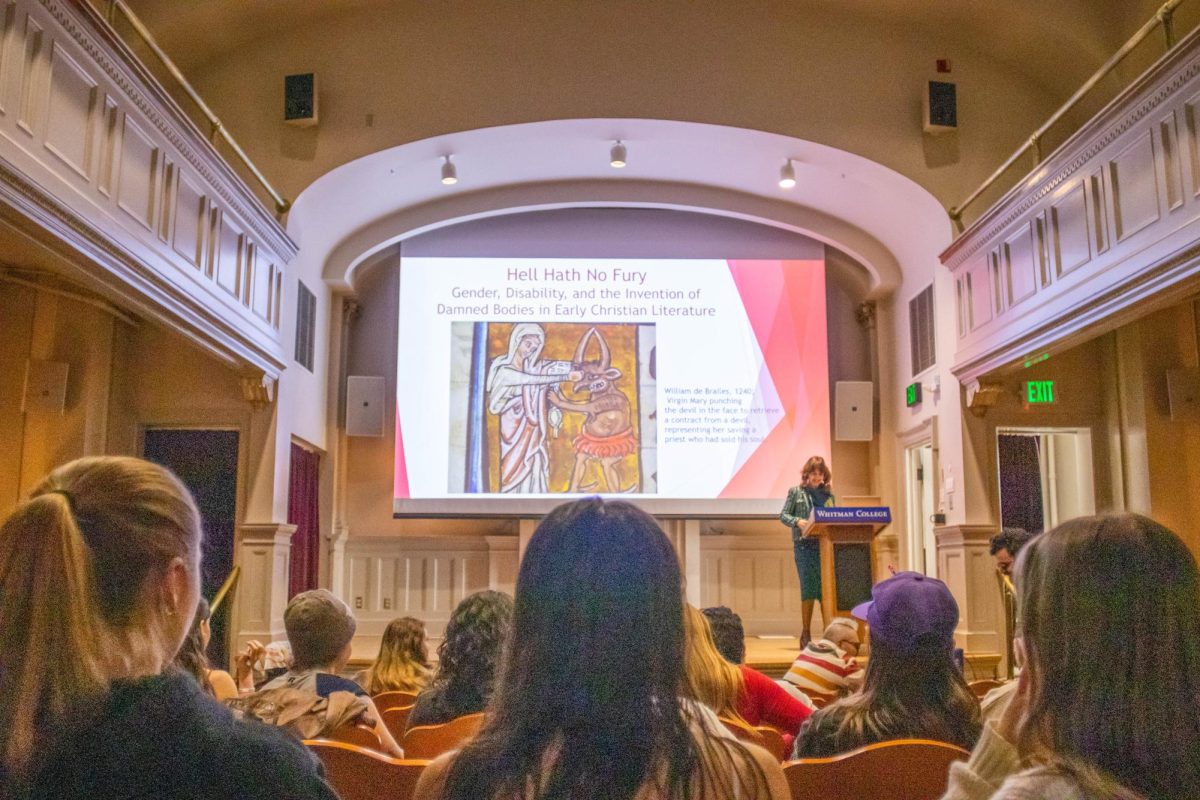
On Friday, April 17, Whitman’s chapter of the American Association of University Professors (AAUP) hosted a meeting with panelists called “Know Your Board.” This meeting was held to participate in the Coalition for Action in Higher Education’s (CAHE) April 17th Day of Action, which they have been holding annually since 2024.
One of the CAHE’s projects is an investigative guide called “An Invitation: Know Your Governing Board.” According to its introduction, the guide offers “an intervention in the ongoing crisis of higher education in the United States,” by providing faculty with information about their institution’s governing bodies.
The event presented and discussed the findings of a report on Whitman’s structure of governance following the CAHE template. The finalized version has yet to be released, but a Preliminary Report was shared with Whitman’s AAUP chapter, which they published on their website. The report contains a list of Whitman College’s Board members, information on their backgrounds and expertise as well as analysis of this information.
One finding notes that “although a few [Trustees] work for nonprofit organizations, approximately half of the board’s members are involved in what is conventionally labeled ‘finance capitalism’ and its auxiliaries (for example, private equity, commercial banking, hedge funds, investment management).” Panelists noted that an academic will be voted onto the Board in the coming future.
One panelist, Chair of Faculty Susanne Beechey, spoke to the event’s goals.
“The Know Your Governing Board event on our campus was part of a national day of action to better understand structures of power in higher education today in the United States. Much of the information in the report is publicly available, but organizing it in one place does allow folks to see patterns, like those Prof. Kaufman-Osborn highlighted,” Susanne Beechey told The Wire in an email.
Professor Emeritus of the politics department, Timothy Kaufman-Osborn, spoke at the event and contributed to the report. He retired from Whitman in 2020 and is now a member of the CAHE’s Steering Committee.
Kaufman-Osborn told The Wire that the report was written by a group of current and former Whitman faculty members. He explained that the CAHE is composed of 35 different advocacy groups across the nation that both believe higher education is being overtaken by “autocratic and plutocratic ends” and are committed to resisting them. Kaufman-Osborn explained that the Know Your Governing Board project makes public information about institutional governance more accessible in an email to The Wire.
“At private colleges like Whitman, these boards hold the final authority to decide the college’s most fundamental issues (for example, to approve budgets, to select presidents, to create new faculty positions, etc.),” Kaufman-Osborn wrote. “We will be in a much stronger position to understand and, when appropriate, to challenge board actions when we know more about their members, their powers, and their fiduciary obligations.”
Kaufman-Osborn has written extensively about a concept he calls the “Autocratic Academy” in his book, “The Autocratic Academy: Reenvisioning Rule Within America’s Universities.” In an article on the Gaza Solidarity Encampments at Columbia University, he elaborates on the term.
“The American academy is legally constituted as what I have elsewhere called an autocratic property corporation. Although this juridical entity presents itself and usually succeeds in passing as an educational enterprise, its formal structure is better designed to ensure the security of the assets, material and otherwise, over which its governing boards exercise monopolistic jurisdiction,” Kaufman-Osborn wrote.
The CAHE writes on their website that the Day of Action is a stand for free, public higher education to be available across the United States, funded through taxation of the rich. It also advocates academic freedom for all faculty, democratic models for institutional governance, freedom to politically dissent for all campus community members and unionization of all workers in higher education.
“It’s definitely interesting times to be researching higher education,” senior researcher at the AAUP, Glen Colby, told The Wire. “There’s an uptick of tension between faculty and administrators and their boards across the country because higher ed is facing a lot of challenges, [including] political and funding challenges, particularly in public or research institutions, not to mention the demographic [cliff].”
The increase in faculty, staff and student organizing on Whitman’s campus aligns with national trends. Colby noted that the AAUP has seen an increase in membership by over 10,000 people.
“Much of [this interest] is aimed at fighting for higher ed in general because higher ed is under attack right now… but there’s a big part of it where they are not happy with how their administration and how boards are handling things these days, so there’s definitely been an uptick in that kind of tension across the country.”
That said, there are some national concerns that Whitman has managed to hold strong against, including the national threats to academic freedom.
“I am not worried that the faculty will lose their power to set the curriculum and course of study at the College, because that is a deeply shared value on our campus and one written into our Charter,” Beechey said.
Beechey added that protections for academic freedom like those she cited in the Whitman College Charter are under threat elsewhere in the United States. It’s these pressures which inspired the “Know Your Governing Board” event.
“However, we are seeing threats to faculty’s purview of the curriculum across the country, particularly in public institutions and in states where lawmakers are seeking to politically intervene in such decisions,” Beechey said. “[S]o it is a good time to be asking these questions and remembering that what makes an organization a College or University is a curriculum and course of study set by professors, the academic experts in their fields.”
Ultimately, the College’s participation in the “Know Your Board” event reflects broader movements in campus culture and desires to possibly reform towards more democratic ends, what some call the Autocratic Academy. Organizations like the AAUP and the Coalition for Action in Higher Education are some of the advocacy groups at the forefront of this coordinated effort.