
*Correction 2/20/26 9:28am: Professor Libby Miller resigned from directing the Maxey Museum and is no longer a staff member. The article previously reported that she was still directing the museum.
*Correction 2/21/26 2:26pm: The wrong last name was originally published for student speaker, Calliope Willis.
Whitman College staff are unionizing. Staff begun distributing union authorization cards on Wednesday, Feb. 18 and debuted as the Whitman College Workers United (WCWU) union yesterday at a rally during the lunch hour of Power and Privilege. Currently, staff members advise the College’s decision making process but hold no power to influence administrative decisions. The college employs 327 full and part time staff, according to the Human Resources page.
Peter Schultz is Whitman’s Learning Technologist for the Sciences in the Technology Services department. He used to teach music and film part time at Whitman before transitioning to his position as a staff member. He has been working at Whitman for almost 12 years.
“[W]e have the Staff Advisory Council, which has been an important voice in building communication within the administrative structures of the college but has no power in the decision-making process. Our union is a complementary approach: we hope not just to tell the administrators about our vision for the college, our needs and concerns, but to actually have a seat at the table and be part of the decision-making process,” Schultz told The Wire over email. “As staff, we do so much to run this college, and it’s very clear that an ‘advisory’ role isn’t enough. We need collective bargaining.”
The Wire estimates that 300 people were in attendance at the Rally. Union songs were sung, blue t-shirts with the WCWU logo distributed and signs made on the grass in front of Cleveland Commons. Multiple Whitman employees, student *Calliope Willis, Jack Jackson and Xiaobo Yuan of Whitman’s AAUP Chapter and Walla Walla Central Ward Councilman, Rodney Outlaw all took the stage to affirm the necessity of the Union. The staff who spoke, including Schultz and Amber Conner, shared their experiences of instability working as Whitman staff.
“This rally is for Whitman’s workers to be able to come together and stand in solidarity. We are seeking a meaningful voice in the decisions that the college makes, which materially affect our working conditions. Today we are going to be asking the college to voluntarily recognize our union,” Director of LGBTQIA+ Student Services and WCWU spokesperson, Shelby Hearn said.
After the speakers concluded, rally attendants marched to the Memorial Building, where WCWU formally requested recognition as a union from President Sarah Bolton by handing her a printed letter.
“…We acknowledge the receipt of that letter and President Bolton will seriously consider its contents,” Vice President of Communications, Gina Zandy Ohnstad told The Wire over email.
WCWU is following National Labor Relations Board (NLRB) standards. NLRB’s website states that at least 30% of employees who qualify for the proposed “bargaining unit” must sign union authorization cards, which are then submitted to the NLRB for a deciding vote to verify the union. The election process can be expedited if 50% of employees who qualify for the bargaining unit sign and submit authorization cards.
Senior Adjunct Assistant Professor of Art History and General Studies, Libby Miller, told The Wire that non-tenure track faculty are standing in solidarity with staff. *Miller used to also work as the Director of the Maxey Museum and Whitman’s Native American Graves Protection and Repatriation Act coordinator, which were staff member positions. She exclusively works as non-tenure track faculty now.
“As non-tenure-track faculty, we are organizing alongside our staff colleagues for a collective voice and for our longstanding contributions to the college to be recognized,” Miller said.
The non-tenure track and staff share similar concerns. Studio Music Instructor for Voice and Director of the Opera & Musical Theater Workshop, Nathanael Fleming, is a Whitman alumnus and non-tenure track faculty member.
“We’re all Whitman workers,” Fleming said. “We all work at the same institution and have a lot of similar concerns. To see people come together in solidarity and say, ‘Hey, I see you, I respect you and I am fighting for you,’ has been amazing to see.”
Over the last few years, the college has announced various strategies to weather the pressures bearing down upon American higher education, including the 2020 Financial Sustainability Review and a budget balancing campaign announced last year.
These pressures are numerous. The “demographic cliff” began last year as an anticipated 15% decline in enrollment due to the children of the 2008 financial crisis reaching college age. The cliff, combined with COVID-19 era financial setbacks, inflation, attacks on higher education and on international student visas by the federal government, have all contributed to an ever-shifting budgetary landscape. Last year, President Bolton announced that the College had a 3 million dollar shortfall between projected 2026 revenue and expenses.
In a June 4, 2025 communication to campus, President Bolton announced that there would be staff layoffs. Ten staff were laid off about twenty days later.
“The excellent work of Whitman’s staff and faculty is the foundation of our college, and we want to do all we can to support the people who make Whitman possible. Unfortunately, given the ongoing financial challenges, we will have to find ways to operate with a somewhat smaller number of employees,” Bolton wrote.
Different initiatives by the college to navigate higher education’s financial landscape have been met with scrutiny. Some measures include restructuring employee benefits and reducing raises. Last semester, the college rolled out a new healthcare plan in response to rising inflation costs.
“The [College’s] budget balancing attempts have primarily been on the backs of its staff and non-tenured faculty. As we head into this spring, we are facing more layoffs. Our benefits, that many of our employees really rely on in terms of how they’ve planned their lives and their family’s lives, are under threat of being cut as well as other significant salary… This is ultimately going to negatively impact our students’ experience here at Whitman. We as workers cannot give our students the experience that they were sold if we are overworked, understaffed and underpaid,” Hearn said.
The college recently purchased the local Brew Pub for 1.5 million dollars, which completes their property ownership between Boyer Ave., North Park and South Palouse streets, according to reporting by the Union Bulletin.
“We’re hearing a lot of frustration with the way budget decisions have been made. The administration has been making a lot of cuts to positions and benefits, citing budget concerns. But at the same time, they’ve invested millions on real estate and have declined to raise the endowment payout rate. They have gathered feedback from the community, but we don’t see it having much of an effect on the decisions. That’s why we feel strongly that we need a voice at the table, helping guide these decisions and making sure the college is considering all of the available options for balancing the budget,” Schultz wrote.
Lindsay Szramek, the Career Development Coach in STEM, told The Wire that staff share a general concern about the purchase because of cuts made to compensation and benefits over the last year in spite of Whitman’s roughly 1 billion dollar endowment. The endowment consists of donations with strict usage guidelines attached. Szramek emphasized that the discourse around the purchase is nuanced.
“I know how endowments work. It’s not that they bought the Brew Pub, it was the messaging about the Brew Pub. It was the cuts to all these other things, and the feeling that Whitman would rather invest in property than invest in their staff,” Szramek said.
Szramek first worked at Whitman for a year and a half as a Visiting Assistant Professor of Geology in 2019. After COVID-19 restrictions began to loosen, Szramek returned to work at the college as a staff-member in the CCEC three and a half years ago. She now runs the STEM Hub in the Science Building, outfitting it with snacks, coffee, used textbooks and art created by her staff colleagues – all to create a better environment for students.
Szramek said that the college’s budget balancing efforts have impacted Whitman’s workplace culture.
“I love my job. I love what I get to do. I love the students, the people I work with and by projection, I love what Whitman wants to be… I’m looking at the long term here. I hope to retire from this place, and so I get very emotionally involved in things. It’s really hard when you see colleagues who aren’t being paid a living wage, or are worried that tomorrow they’re going to get laid off…” Szramek said. “[It makes me wonder,] why are you working here? You could work at fast food and make more than you do here.”
Szramek wiped tears from her eyes while discussing this.
“I got involved [in the staff unionization effort] after serving on the Staff Advisory Council and hearing how bad things had gotten for a lot of my colleagues,” Schultz said. “They have to work extra jobs just to make rent. Some of them are unable to leave for other jobs that might have better working conditions and compensation because they are hoping that in a few years the tuition benefit will help them afford college for their kids.”
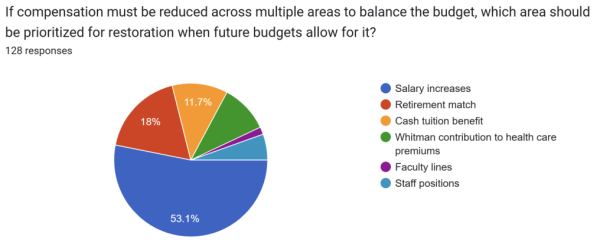
The tuition benefit is one of the benefits being considered for cuts as part of the College’s greater budget balancing campaign. A December 2025 survey by the college asked a hypothetical question.
“If compensation must be reduced across multiple areas to balance the budget, which area should be prioritized for restoration when future budgets allow for it,” the survey states. For print-readers, see this figure online at www.whitmanwire.com
According to the Massachusetts Institute of Technology’s Living Wage Calculator, a living wage in Walla Walla for a family comprised of two adults working full time for the same wage and two children is $28.50 per hour.
“Full-time staff work a minimum of 35 hours per week and 52 weeks per year, including vacations. Full-time staff on the Whitman campus may work 35 hours, 37 1/2 hours or 40 hours per week depending on the department,” Whitman’s website states. 35 hours per week for 52 weeks equates to 1,820 hours.
The college has multiple open positions listed on Bamboo HR, which provide a frame of reference for staff and the non-tenure track salaries.
A full-time custodial position at Whitman College is offering $37,569 in annual salary. Divided by the number of hours per year that the college considers to be full-time, this salary ranges from $20.60-$18.60 per hour, depending on whether they work 35 or 40 hours per week.
A full-time Assistant Athletic Trainer position is also listed on Bamboo HR. The listing requires a master’s degree in athletic training or a related field. This position offers $48,510 – $50,468 as a salary, which works out to $26.70-$27.7 per hour.
“[Some staff members are] working scared, with no protection against sudden firing or layoffs. But they believe in Whitman just enough to stay… Meanwhile, my friends who work in unionized environments such as Walla Walla Community College have been able to negotiate contracts with standardized pay increases, job protections, and other benefits. And their workers can have a direct role in bargaining these contracts” Schultz told The Wire over email.
Miller shared what a vision of Whitman’s future could look like.
“First and foremost, the future of Whitman has to be one where equity extends to every single person on this campus, where equity is not just a buzzword, but is at the heart of the way that the college treats its faculty, its staff, its student workers, its students,” Miller said. “Equity is not just about outcome. It’s about process. It’s about recognizing that we all have a stake in how this place is run in order to achieve something that goes beyond core values listed on the website.”
Miller also expressed that the staff and non-tenure track are looking forward to working with the administration to make Whitman a better place.
“There’s a lot of kindness [here]. We can build on that as a really positive and central structural factor within Whitman and integrate that into how the institution is run. That is how we address the very real pressures that higher education is under currently, by doubling down on the things that we do really well, which is take care of our students and take care of each other,” Miller said.
Now that Whitman College Workers United has begun distributing union authorization cards, it is only a matter of time before they submit the cards to the NLRB and petition to be recognized as a union by Whitman College’s administration.




James • Mar 10, 2026 at 3:44 pm
Why did Libby Miller resign? Was she forced out by the administration or did she resign of her own will?
2022 alum • Feb 21, 2026 at 6:51 am
I remember hearing that the reason the staff don’t get an email list serv (there’s one for all faculty, one for all students) was to prevent staff unionization efforts. Glad to see this happening
Ray L Hansen • Feb 20, 2026 at 12:29 pm
A union is long overdue. Parity salary and benefits are a huge need but also there is no entity at Whitman in place to protect employees from being arbitrarily fired-should you displease the administration in any way. I was an employee of the Security Department. I successfully defended an accusation with evidence. I had been told I would keep my job if I was vindicated however both HR and the Security Director lied to me. Dean of Students, Kazi Joshua, oversees the department and pulls the strings on what happens-but will deny it. Prior to my “release” Craig McKinnon-a 40 year employee was also dismissed without just cause and recently another security staff member was fired with no evidence. I can only speak on what I personally saw and experienced but I have heard of injustices in other department such as maintenance. Union-YES
Anonymous • Feb 20, 2026 at 9:06 am
Lots of good context here. However, one significant question that jumps out is how the union can claim to be fighting for equity for all staff when they are excluding a large portion of the staff due to their position responsibilities as staff supervisors? This leaves out at least 1/3 of the staff population who are subject to the same stagnant wages and loss of benefits, and will create division among colleagues, weakening the staff community.
Anonymous • Mar 9, 2026 at 8:23 pm
Thanks for asking! This exclusion is a legal requirement for union membership per the National Labor Relations Act–not the organizers’ choice. Supervisors cannot be in the same union as their supervisees.