
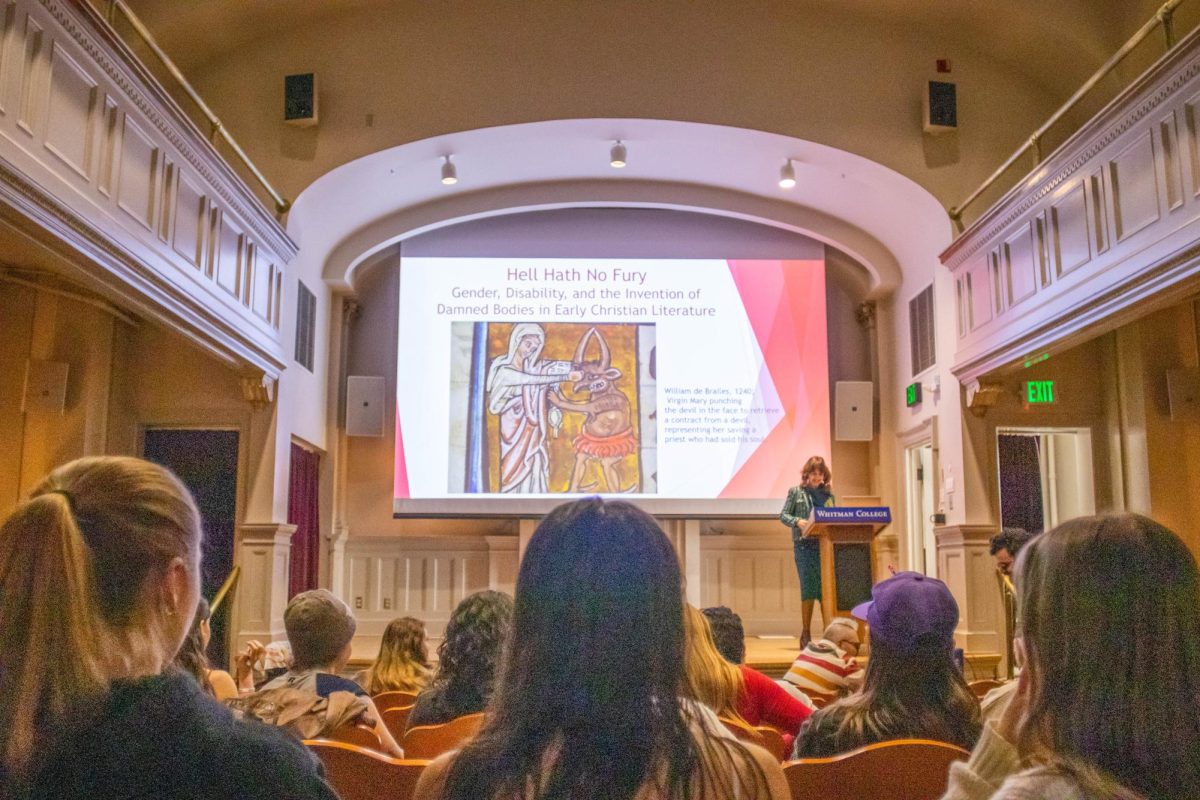
On April 16, Meghan Henning lectured on her book “Hell Hath No Fury: Gender, Disability and the Invention of Damned Bodies in Early Christianity” in the Kimball Auditorium.
In her book, Henning analyzes how ancient depictions of Hell play on fears of disability. In her lecture last week, Henning presented how these images reflect cultural ideals linking femininity and disability to weakness.
From a young age, Henning has thought about how the power of ancient religious texts can work as a means to understand contemporary life. In an interview with The Wire, she explained the catalyst that started her lifelong career in Christianity studies.
“My work began when I was a teenager and my family experienced a lot of trauma,” Henning said. “[I wanted] to understand how two different people could read the same religious text and apply it and interpret it in, on the one hand, ways that were helpful for my family and I, and on the other hand, in ways that were hurtful.”
Influenced by this experience, Henning went on to earn her PhD in New Testament studies and now teaches as a Professor of Christian Origins at the University of Dayton.
Professor of Classics, Daniel C. Smith, organized Henning’s visit to Whitman. In an email to The Wire, Smith shared how he and Henning connected.
“I met Professor Henning at an academic conference years ago and have closely followed her work ever since. Her careful textual analyses and her skillful integration of ancient history and contemporary theories of the body make her an ideal guest from whom our community can learn,” Smith said.
For Henning and Smith, who both specialize in disability studies, ancient texts provide insight into stigmas around disability. Henning explained that her work focuses on tracing these ideas through historical texts.
“All of my research is focused on the religious language around human suffering and disability. The impact [this language] had in antiquity and the impacts that it has on contemporary life,” Henning said.
Henning argues in her lecture that punishments depicted in Hell mirror the experiences of blindness and deafness, and these texts both police and hyper-sexualize women’s bodies.
“The damned body is disabled and the disabled body is damned,” Henning said.
She went on to say that these archaic notions are directly linked to contemporary ideas about which bodies are normal. “Body normativity” refers to the system that standardizes qualities such as youth, athleticism, whiteness and masculinity. In her analysis, these bodies are portrayed as the ideal, while all others are considered inferior and flawed.
In addition, Henning argues that while normative perspectives on the body are pervasive, they are also socially and culturally constructed, meaning they can be changed.
“Disability studies helps us understand that body normativity is something that we create as a culture,” Henning said. “But we are able to analyze that. We can enact cultural change and we can work together to change how we understand what is ‘normal.’”
Smith agrees, adding that works like Henning’s have the potential to transform how we culturally conceive of the body.
“Close textual analysis, careful attention to history and formulating good questions… can lead someone to rewrite entirely the way we understand our world,” Smith said.
Emmali Simmelink, a third-year Classics major and the Classics Club’s President of Outreach, attended the talk and spoke about the relevance of Henning’s work to our contemporary moment.
“History repeats itself,” Simmelink said.
Despite this repetition, Simmelink reflected on how we have moved on from a lot of historically normalized oppressions like some of those against gender and disability.
“[It is] helpful to consider when you’re looking at how the world is going now and are able to say that maybe this too shall pass,” Simmelink said.
Henning’s work aims to help readers identify how discriminatory narratives in ancient texts persist today. Her studies on ancient stigmas around gender and disability allow us to push against “normative” understandings of the body and towards more inclusive understanding.


