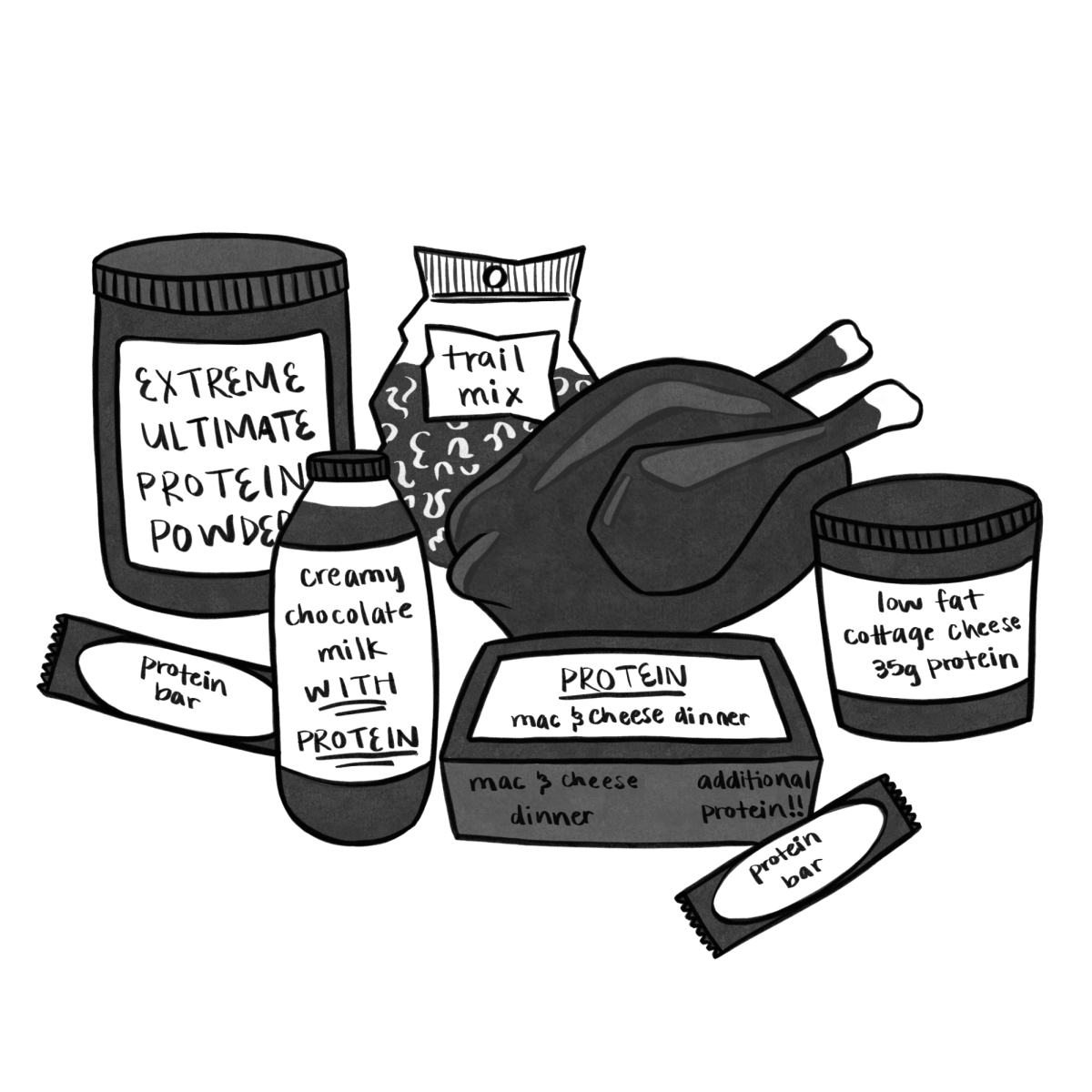
Have you ever craved a tasty, creamy scoop of cookie dough ice cream… with extra protein? If you buy a container of Protein Pints ice cream at your local Safeway, you could have just that! And not only is ice cream waiting ready for your post-workout self, the shelves are lined with everything from ingredients to blend your own protein shake to double-chocolate protein waffles to protein matcha.
This trend, although having been slowly built up over the past couple of years, seems to have very recently taken over media spaces and grocery stores. It has certainly coincided with the rise of fitness influencers and testosterone-filled podcasts like Joe Rogan’s “The Joe Rogan Experience”, where he gushed about the protein-heavy “carnivore diet” to his listeners.
“The best I ever felt — like, literally, the best I ever felt, all throughout the day, was when I was on the carnivore diet,” Rogan said.
By “carnivore diet,” of course, he means no fruits, vegetables, nuts, grains — just animal products. This kind of rhetoric has helped turn protein from a basic micronutrient into a cultural performance of discipline and masculinity.
Not all marketing of this trend is from men like Rogan, however. TikTok creators of all kinds have begun promoting protein like it’s the cure to all problems. One video shows viewers how to make protein brownies, minus most of the typical brownie ingredients. But if you have powdered monkfruit, pumpkin puree, greek yogurt and, of course, protein powder lying around, you’ll be all set to make these protein brownies yourself.
This hyperfixation on protein has extended past kitchens and social media and into grocery store aisles and even coffee shops. With the slogan ‘Protein never tasted so good,’ Starbucks recently launched protein cold foam. If you order a protein latte with protein cold foam (the flavor options are endless: Banana? Gingerbread? Matcha? The choice is yours), you could get a mighty 36 grams of protein in your 16 ounce drink . This whopping amount is notably equivalent to that of a 1/2 pound piece of steak.
Likely as a result of social media pressure and brand marketing, people are clinging to protein as some kind of magical food, which was highlighted in one report by Cargill.
“61% of consumers report increasing their protein intake in 2024, up from 48% in 2019.”
In order to better understand protein’s true role in nutrition, I spoke with Dr. Jim Russo, who is a Professor in Whitman’s Biochemistry, Biophysics & Molecular Biology (BBMB) and Biology departments. He teaches a 200-level Biology course called Nutrition & Metabolism, where students learn about individual nutrition as well as public health. Thinking about personal nutritional habits is a key part of this class.
“Students think about their own dietary intakes… and [ask the question,] how do we think about global food access for both individual health and planetary health?” Russo said.
Russo said that while protein is a vital macronutrient for everyone, consuming excessive amounts of it isn’t always necessary. Voices promoting overconsumption of protein have been blown out of proportion, leading to misinformation about how much protein is actually enough.
“The 0.8 grams per kilogram of protein that is the recommended daily allowance does probably provide the amount of protein needed for adequate physical, immune kind of health,” Russo said.
He added that for most Americans who are not living in a food insecure environment, this is usually attainable simply through daily meals, without supplements. Russo expressed that getting protein through whole foods was important for the same reasons that it’s generally accepted to prioritize unprocessed foods.
“By putting protein into all these things, it makes people think that the highly processed foods that we are making are somehow more nutritionally beneficial [than whole foods],” he said.
Many of these “highly processed” foods are developed simply to cram the most amount of protein in the least amount of calories, neglecting needs for other types of nutrients. When foods like certain shakes are marketed as “meal replacements,” but don’t actually contain significant amounts of certain types of ingredients, it leads to deficits of vital nutrients.
“If you’re getting all of your protein [from] this processed whey protein or pea protein,” Russo said, “you’re not getting all the other nutritional components that come from whole foods. Excess protein cannot make up for things like fiber and B vitamins, for example”.
Sophomore Coco Ragan said it’s “really good” that people are feeling motivated to get the amount of protein they need, and also supported Russo’s message, adding that “fiber should be a trend too.”
Another thing Russo emphasized was that protein doesn’t always need to come from animal sources.
“Even someone who’s eating completely vegetarian can get plenty of protein,” he said.
He added that nuts, beans and lentils are high not only in protein but B vitamins and dietary fiber, “giv(ing) you a broad spectrum of ingredients.”
A New York Times article by Kim Severson discussed a recent decline in vegetarianism, likely due to this protein fad. Meat products are widely regarded as one of the easiest sources of protein, and people are sticking with them.
“There is this perception that protein is an end-all, be-all to health, and meat is an immense shortcut,” Melanie Zanoza Bartelme, a global food and drink market analyst, said to the New York Times.
“[Meat provides a] convenient, less-processed way to satisfy [our] obsession with protein,” Severson wrote.
Citing the Cargill report, the article said that meat consumption in the US went up 7% last year from what it was before the pandemic.
When I asked Russo about his thoughts on this protein-focused trend, he expressed that it has been largely influenced by desires to make money off of new products. They’ve taken the idea that protein will instantly give someone muscle and rolled with it.
“It’s 99% marketing,” Russo said. “[Brands are] capitalizing on a certain ethos of wanting to build more muscle… We’ve gone through these types of cycles where something becomes very highly marketed as a food need.”
Looking closely at this kind of trend tells you a lot about other societal standards, like unrealistic body ideals. In our culture, certain body types are often associated with different types of foods. And while today’s society prides itself on promoting body positivity and celebrating people the way they are, it’s clear when you look at modern media that we’re not there yet.
Our language, for example, disguises the perpetuation of body ideals as humor or innocent sarcasm. Slang terms like “bigback” and “fatty” have become trendy, and while the people who use them rarely mean harm, they have connotations that are often left unacknowledged. Eating disorder therapist Zöe Bisbing told Fortune magazine that this language stems from biases ingrained in our society.
“It has a lot to do with this really, really entrenched anti-fat bias in our culture that normalizes microaggressions toward fat people,” said Bisbing.
Because of language and other factors in our culture that perpetuate unrealistic body ideals, it’s not uncommon for people to feel like they need to eat certain foods to get a certain body. And due to marketing strategies and the media, many people are convinced that protein is that perfect food. Knowing that modern beauty standards celebrate bodies with lean muscle, brands have latched on to the misconception that eating more protein will make you look a certain way.
“It’s a stupid marketing scheme,” said senior Ollie Fox.
“Companies have caught on [to the idolization of protein],” Ragan said. “They’ll just put the amount of protein in the [product] right on the label. It catches your eye… and most people won’t read the [nutrition information].”
Another common strategy is endorsements for a product from people with a certain “ideal” body type. On the front of the website for Khloé Kardashian’s protein popcorn brand Khloud, for example, the celebrity is pictured in full glam holding three bags of the product.
Another notable example of this is the ultra-processed David protein bar, which is advertised on its website next to a bodybuilder and atop the chest of a perfectly manicured and made up woman, who appears so flawless it’s unclear if it’s AI or not.
While not directly stated, there seems to be an underlying message that eating these foods will make you look similar to the people who endorse them or are pictured with them. When this expected result doesn’t come, the misconception can be detrimental to our self-esteem as consumers because, in reality, protein alone won’t do much.
“If people want to increase muscle mass through resistance weight training, then, yes, increasing their protein intake can help them do that,” Russo said.
But you’ve still got to work. Protein helps build and repair muscle after exercise, but resistance weight training is the other piece of the puzzle.
While these kinds of products can be beneficial for certain types of people, the way they’re marketed has created a grave misconception in modern discourse. These novelty products make protein more approachable for some, but they’re certainly not always “meal replacers.”