
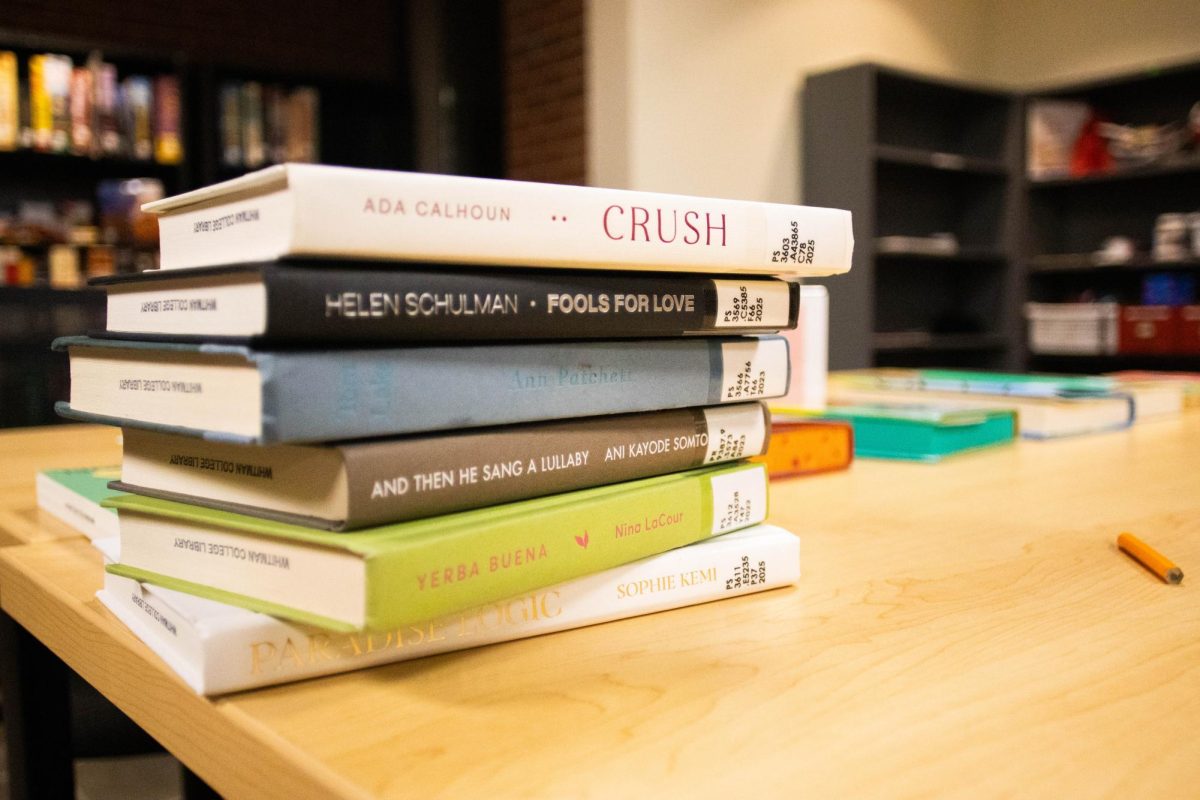
On Thursday, Feb. 12, librarians hosted a Smut in the Stacks event to make space for students to freely discuss contemporary novels and meet peers with similar interests. Smut in the Stacks typically focuses on presenting and recommending romance novels to attendees. This year, librarians spoke with The Wire to discuss the importance of reading.
In an interview with The Wire, librarian Bridget Scoles explained that the event sought “to create an area, an event where people feel comfortable” and “to create a safe, affirming place, really emphasizing BIPOC and queer romance.”
Scoles emphasized that the library is a space for building community around readers as well as a place where readers may explore new genres and learn from the library’s materials.
Penrose Library specifically focuses on curating a diverse collection of work for both the Whitman and the greater Walla Walla community. Because the library is a public space on campus, it attracts visitors from across the Walla Walla community and often hosts events in addition to expected library programming, like research help or book check-out.
Professor Jessica Hines, one of many on-campus patrons, pointed out that libraries are one of the few spaces where people can engage with each other in a free and open manner.
“Libraries are one of the last real free spaces. It’s a space that’s for communities in general,” Hines said. “It’s one of the disappearing third spaces.”
Librarian Emily Pearson also emphasized how libraries support patrons by providing public learning spaces. For Pearson, the library is a space that invites learning without judgment.
“You can be exposed to other cultures, other people [and] other ideas in a safe space…You’re having your own time to reflect on that experience or what you’re feeling by reading something,” Pearson said.
Pearson added how crucial it is to continue the practice of reading and how contemporary texts or materials in the library can offer a less intimidating start to this practice. In her work as a librarian, she has noted that some works can feel too academic or prestigious to read casually.
According to Pearson, many students who once loved reading lose that joy while in school or pursuing research. As a solution to this feeling of burnout, she suggests recreational reading to re-engage with texts and find joy in the process.
“We’ve kind of lost the ability to follow plots. Genre fiction, like romance, without diminishing, can be really engaging – deep storytelling, deep character development but also softer landings. [Contemporary or recreational reading] can be a good way to reengage with reading,” Pearson said.
Scoles endorsed the same recommendation for recreational reading. She also acknowledged how the stresses that students face can diminish the joy in reading and asserted that reading with no stakes can be very beneficial.
“I’m always pushing a recreational reading agenda on campus…I think it’s a really good way of just relaxing from the daily stresses of academic life,” Scoles said.
Professor Hines specified how medieval romance and general literature may also provide a low-stakes opportunity to learn about older texts and societies for those who are not as interested in reading contemporary works.
“[Medieval literature] is a wonderful space where we as contemporary people can be invited to see what are different, perhaps more playful, more experimental, ways we can think about gender, sex or embodiment,” Hines said.
Librarians and patrons alike encourage students who feel burnt out from reading to take advantage of spaces like the library, where they can read for pleasure as a way to get back into the practice. Scoles and Pearson, who organize events like Smut in the Stacks for the library, share how library spaces and the activity of reading grant opportunities to learn about both ourselves and our societies.


