“If the small town is wholly sacrificed there will be sacrificed along with it some continuity of face-to-face relations, an awareness of identity, a striving to be part of a compassable whole, a sense of counting for something and being recognized as a person.” – Max Lerner, America as a Civilization.
This passage was written in 1933, as America began to move away from small-town life and toward urban neighborhoods. Communities that used to be a given became harder to find, and people had to work to realize them again. Max Lerner, an American journalist and author, described this change.
“The small town was undercut by the big changes in American life — the auto and the superhighway, the supermarket and the market center… It was the city and the suburb — the cluster-city complex — that became the focus of working and living, consuming and leisure.”
Despite America’s shift away from small-town living, some communities — like Walla Walla — have upheld many of the values Lerner highlighted in his book. As this type of community-oriented town has become less common over the years, we grow luckier to be a part of one. One key way this has been done is with the presence of third places.
The phrase “third place” was first coined in 1989 by Ray Oldenburg in his book The Great Good Place.
Such places exist, he wrote, “after home, first, and workplace, second, and are informal public gathering places… The first and most important function of third places is that of uniting the neighborhood.”
Third places can be public libraries, coffee shops, churches, community centers — anywhere that people are welcome to gather, no matter who they are. Even better if there is no financial requirement to spend time there, or a low one. These places promote those face-to-face interactions and that sense of belonging highlighted by Lerner.
One Walla Walla example is Colville Street Patisserie, owned by David Christensen and Tiffany Cain since 2008.
“It [was] started in 2005,” Christensen said, “[by] a guy who moved here to work at a fine dining restaurant [and] didn’t love that life. [He] saw the opportunity to do something like this… it was the only dessert and pastry place available at the time.”
A local favorite, the patisserie serves customers from all over the community, as well as tourists. Asked whether he considered it a third place, Christensen said yes.
“The buy-in is pretty low, and you can stay as long as you want. So people do take advantage of that, and we’re happy to see them,” said Christensen.
Christensen mentioned one time when the patisserie served as a community space, saving some neighbors from a potential wedding disaster. When a couple lost their venue, the patisserie opened its doors for them.
“The guy who was gonna marry them was a good customer of ours,” he said.
The couple “ran across the street to get some flowers,” and held the ceremony in the shop.
More commonly, Christensen said, the patisserie acts as a meeting space for a local political group and hosts the occasional music event.
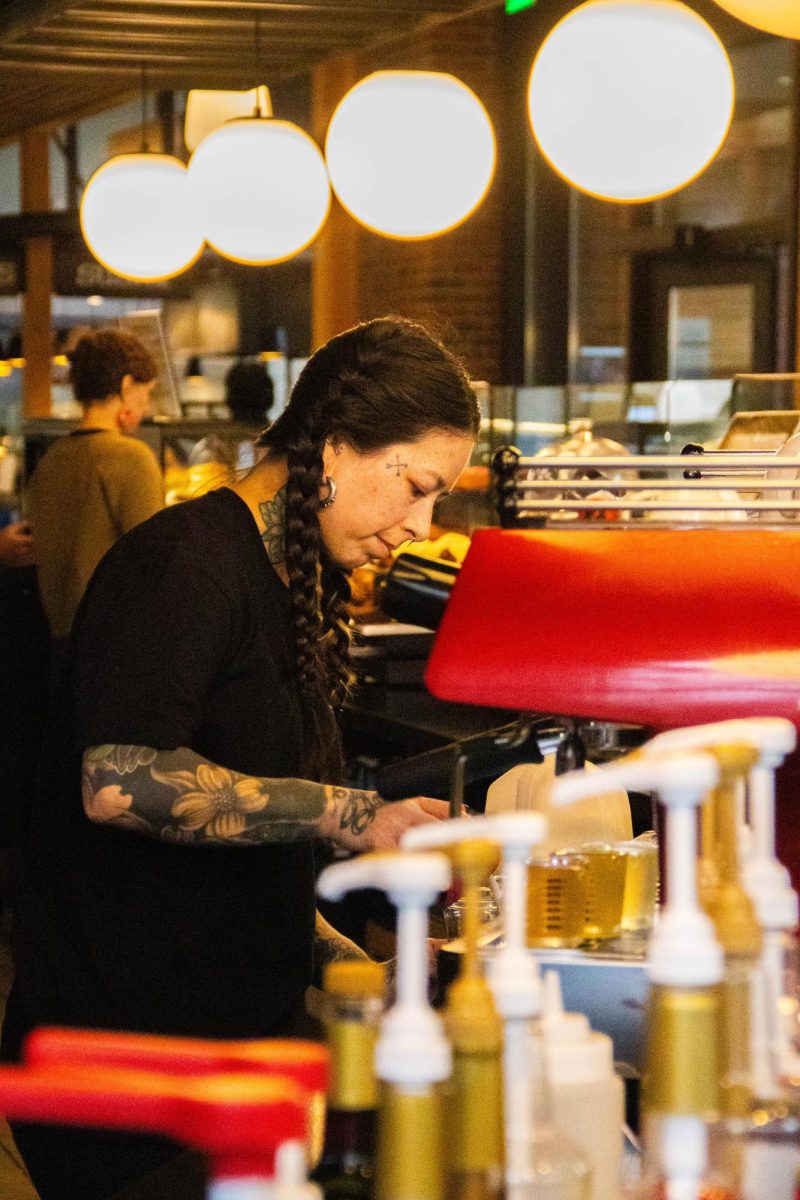
Heather Goodwin, the manager at Coffee Perk — another downtown gem — emphasized how third places are more important now than ever, especially with the rise of remote work and individualistic lifestyles.
“Everyone gets stuck in their rut of being at home away from people. Having a coffee shop to go interact with people gets you out [of that rut],” Goodwin said.
Goodwin noted that since its opening in 1996, the staff at Coffee Perk has enjoyed serving coffee to the community. They especially enjoy developing relationships with college students and seeing them grow as they move to town and grow over four years.
Both Colville Street Patisserie and Coffee Perk serve as a place to gather, but Oldenburg suggested that a third place like them does even more. He described them as having at least four further functions.
First is the “port of entry,” or space for folks new to the community to meet their neighbors, or for visitors to begin their stay with a warm welcome. The next use a third place has, Oldenburg wrote, was to sort people based on their interests, serving two purposes — bringing together people who are alike, and in a more traditional sense, increasing the neighborhood’s productivity.
“In true communities… People work together and cooperate with one another to do things which individuals cannot do alone. Third places serve to sort people according to their potential usefulness in collective undertakings,” Oldenburg wrote.
Next, he wrote, a third place is a staging area, a gathering place in response to a crisis or to begin a protest. When governments and zoning laws limit relief areas, for example, third places can serve as a place of refuge for people who need more than just shelter, but community too.
Lastly, he acknowledged the importance of spaces for people of all ages to share.
“Among the noblest of third place functions, rarely realized anywhere anymore, is that of bringing youth and adults together in relaxed enjoyment.” This need, he wrote, is due to “the rampant hostility and misunderstanding between the generations.”
Even decades later, in Walla Walla, that need is still present, but is certainly fulfilled by some of its community spaces. With 67% of our population being under 29 and over 60, it’s important that the age gap is bridged. Christensen emphasized that third places like the patisserie can achieve this.
“We do a pretty good job of getting a full cross section of the community,” he said.
He gestured around the shop, and I could see someone from each group as he mentioned them.
“Students from all three colleges — you can see here — we’ve got professors, retired people, other business owners, regulars,” he said. “Working people in for coffee and pastries.”
Many of our first and second places are filled with people like us, especially with regard to age. Whitman’s campus is only a block away from the Washington Odd Fellows Home, one of Walla Walla’s senior living communities, yet the two circles don’t tend to intersect. Lucy Brown, leader of Whitman’s new Adopt a Grandparent program in the Career and Community Engagement Center, highlighted why it’s important we connect as communities.
“Forming interpersonal connections with the residents of Odd Fellows creates intergenerational relationships that are key to being a member of the greater Walla Walla community,” she said.
This is where third spaces can come in. As we break out of our residential bubbles, we get the opportunity to interact with people different from us — something that’s integral to creating a meaningful neighborhood community.
Third places serve everyone, no matter their identity, and allow for an environment where everyone knows just about everyone else. It doesn’t necessarily have to promote close friendships, but instead, a familiarity with the people who share a neighborhood. It was clear when talking to Goodwin that this was true about Coffee Perk. I watched people say goodbye to her as they were leaving, certainly regulars whom she had gotten to know. For her, she said, the shop creates a coffee family.
“My regulars that come in all the time — a lot of them turn into being like family. They all say bye to me before they leave, and I try to do the same to them,” Goodwin said.
Goodwin also emphasized the phenomenon where third places like Coffee Perk put people at ease with each other.
“It’s kind of like Cheers. You know everyone knows everyone. In a smaller town, you can reach out and try to know the people that you see each day,” said Goodwin. “There’s different regulars that come in — they don’t know each other, but they make sure to say good morning, because they see each other here every day. They know each other from just being here.”
And while the shop sometimes hosts groups of folks that already know each other, those groups grow by meeting other groups, she said.
Beyond just coffee shops, Walla Walla features other third spaces — the Walla Walla Public Library, for example, hosts a weekly knitting group, Dungeons and Dragons group and a space for teens to meet for creative endeavors, in addition to providing a safe, comfortable space for anyone in the community with no cost. Parks feature another place for people to gather. Menlo Park and Howard-Teitan Park host basketball courts, and the Mill Creek Sportsplex features eight pickle-ball courts that overflow with community members on warm nights.
As college students, we are lucky to have our own campus community. But it is worth escaping out into the town every once in a while. Being present in a third space brings us together with neighbors in a way that sparks a feeling of being a part of something bigger.