In the early days of last month, Taylor Swift released her latest album and broke a music industry record. “The Life of a Showgirl” came out on Oct. 3, and within its first week, the album sold over four million copies. Out of those sales, 1.2 million were on vinyl records, a form of audio storage that has not been dominant since the late 80s.
The resurgence of vinyl and other physical forms of audio storage is a curious phenomenon. In many ways, the world has turned away from analog audio storage in favor of digital. This is evident in communication trends. For consumers in the US, digital texting and calling have surpassed analog methods, such as landlines or postal mail, for decades. It can be seen in news media consumer trends. Within the past five years, no more than 25% of U.S. adults have reported getting their news from radio or print.
Consequently, it is not surprising that this pattern can also be observed in the trends of music consumption. A 2022 survey conducted by the International Federation of the Phonographic Industry found that digital streaming is the most popular method of music consumption. Radio was also found to be a common means of music consumption, but less than 10% of respondents used physical music as their primary listening method.
This may lead one to wonder about the differences between analog and digital audio storage. To answer this question, we must first define what audio is.
“If you think about sound when we experience it, it’s vibrations, a wave in matter,” said Professor Jordan Wirfs-Brock.
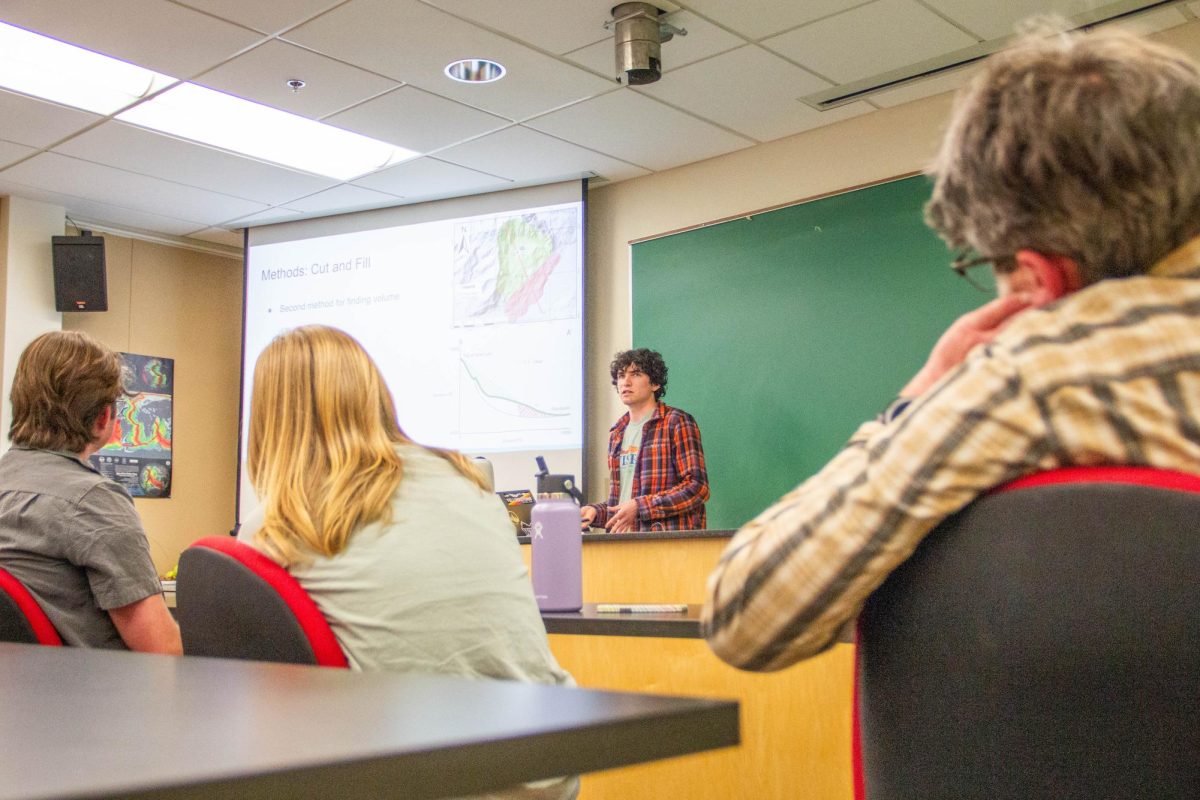
Wirfs-Brock is a professor of Computer Science at Whitman, specializing in information sciences, which encompasses the interaction between humans and technology. This semester, she’s teaching a course entitled “Your Life in Sound”, which examines how digital listening technologies change the way people relate to sound. The process of storing audio is central to her course.
“When we have to turn [sound] into digital audio, we have to have some kind of instrument that can catch those vibrations and log them,” said Wirfs-Brock. “The actual thing that we’re capturing when we make a digital audio file is the distance of displacement of a microphone that we’re vibrating. So we go from our in-the-world experience of sound — which is mediated through our brains and our perception — to capturing digital audio, which is a string of measurements of displacement.”
When audio is recorded in an analog format, vibrations are captured by etching grooves that replicate sound waves into a physical medium. The first device for this purpose was a phonograph, created in 1877 by Thomas Edison. His device used wax cylinders to store sound, the precursor to the flat disc. The biggest difference for the listener, however, between analog and digital comes in when sound is played back. With analog recording, the audio is played back continuously, just as sound is produced naturally.
Conversely, digital audio is played back at a rapid interval rate, based on recorded samples.
“With digital audio, it has to sample a measurement at a specific time interval, and that time interval is really rapid. Most digital audio files are sampled at around 44,100 samples per second. You hear 44 kilohertz, which means 44,000 times a second; you are getting one of those numbers. We’re getting so many recordings that our ears can’t even resolve finer than that,” said Wirfs-Brock.
Digital audio storage introduces a world of new possibilities. In decades past, one would need access to a recording studio in order to store and manipulate audio. With the ability to record and store sound on personal devices, audio engineering has become more accessible to a wider audience than ever before.
Isaac Vale, a junior majoring in Film and Media Studies and president of Whitman’s Music Making Club, is one such individual who has leveraged the creative potential of digital audio storage.
“I have an audio interface, which I run my microphone through, and then the audio interface is plugged into my computer, and that’s all I need,” said Vale.
Advancements in generative artificial intelligence have added a new layer of potential to the world of audio. Those in music production, such as Vale, are cautious about these new potentialities.
“There are programs that create chord progressions instantly for you,” said Vale. “On one side, I can appreciate it for what it is. On the other side, there’s going to be a lot of music that’s going to come out, and you won’t know if it’s created by AI or not.”
The shift towards the advanced features that come with digitally storing audio is clear, but that doesn’t mean that analog audio has completely gone away. The playback of both types of sound storage can be heard locally at Whitman’s student-run radio broadcasting station, KWCW 90.5 FM.
“I think the ease of digital is really nice. You can play anything that’s on the internet on your show, but I find playing records and CDs a lot more fun,” said Lucky Eden ’26, KWCW’s general manager.
Radio broadcasts have traditionally been an analog medium for sharing audio information, meaning that they use physical quantities to represent information, rather than encoding it into digital form. Radios function by using a transmitter to convert audio input into an electrical signal. In earlier years of radio broadcasting, the input could have been a voice or live music picked up by a microphone, or a physical vinyl record or compact disc played from a record player or CD player. The signal then modulates a specific electromagnetic wave, which is emitted from the radio’s antenna. These signals are sent out using either amplitude modulation (AM), in which the “channels” are differentiated by the strength of the signal, or frequency modulation (FM), in which “channels” are differentiated by the number of waves per second being emitted. The wave is picked up by radio receivers, which are the personal devices one might have in their car or home that can tune in to a specific amplitude or frequency and convert the signal back into audio that we can hear.
To listen to KWCW’s broadcast, one can tune in with their radio, listen online through the livestream or use an online radio app. According to Eden, tuning in on the radio is the standard method; each option comes with its own benefits, creating a unique listener experience.
“One really cool thing about one of the apps I use is it tells you the metadata for the songs while they’re playing,” said Eden. “It’ll tell you the artist name, the song name and the album name, which isn’t something that’s broadcast through a radio.”
The station began over 50 years ago in 1971, broadcasting from Reid Campus Center. As Eden explained, music sharing has always been a huge focus of KWCW’s broadcasting.
“Of course, then all they had were [vinyl] records… then we transitioned to CDs in the 90s. Most of those were sent to us by record labels or by independent artists who wanted us to play their music. Then, as MP3 downloads and digital streaming became more pervasive, DJs started using those instead,” said Eden.
The vast array of music available online makes digital audio a convenient option for music enthusiasts. As a result, it’s a more popular choice for student-aged broadcasters. However, the convenience factor is not the deciding point for everyone who broadcasts on KWCW.
“The majority of DJs at the station definitely use a streaming service like Spotify or Apple Music to play their music for their show,” said Eden. “But there are a lot of DJs, including myself, who still use physical music, whether it’s records and CDs that they bring in or stuff from our collection. A lot of the community member DJs definitely choose to use records or CDs.”
Older generations seem to have a nostalgic attachment to physical forms of audio, but there has been a notable increase in demand for vinyl among all age groups. Eden credits this resurgence to Record Store Day, an event that first took place in 2008, with the intention of preserving the culture surrounding brick-and-mortar music stores.
“Record Store Day basically single-handedly brought back vinyl records as a novelty item. And from there, artists started selling them again. Big artists like Taylor Swift really popularized buying records. So all of a sudden, this form of media that had pretty much gone away once CDs were invented in the 90s became super prevalent,” said Eden.
There is something to be said about the value of physical music. On one hand, a physical record is more vulnerable to damage than a digital audio file, but imperfections within playback can create a unique listening experience. It extends beyond just the audio itself.
“I think people of our generation, where most of our lives are spent online, really value something physical that they can hold on to,” said Eden. “I definitely think that buying records and CDs will continue at least in the near future.”
Although digital audio storage appears to be the future, the vinyl resurgence suggests that older audio formats still have a place within the music world today.