Whitman’s theatre department debuted Ellen McLaughlin’s “Iphigenia and Other Daughters” this Thursday, October 30. The play ran through the weekend, with the final show taking place on Sunday November 2. Rehearsals for the play began in September.
Ellen McLaughlin, an American playwright and actress, adapted a series of classic tragedies to center women’s voices and perspectives. McLaughlin’s version of the ancient play “The Fall of the House of Atreus” features almost all female characters, with Orestes as the exception. The plot surrounds a single family’s relationship after the Trojan War, vengeance and women’s isolation in a private sphere.
Sophomore Lena Dozeman, who played Iphigenia, commented on the performance of this play in our political climate.
“I have so many feelings of rage and helplessness about the world that were so easy to tap into for this role. Our bodies are not under our control … in so many ways we are regressing further and further into these old patterns of oppression. People are not as motivated to resist as they used to be. All [of that was] at the forefront for me,” Dozeman said.
Dozeman also felt that “Iphigenia and Other Daughters” gave performers and audience members a chance to connect with political movements through storytelling. The play emphasizes sacrificial death as ultimately meaningless and consequential to the family featured in the play.
“By telling stories such as this one, we are more aware of our responsibility to identify and eliminate these cycles when we see them. This story is about one death and the irreparable impact it had on thousands of lives over multiple generations, so imagine the impact of tens, hundreds, thousands of deaths,” Dozeman said.
The play is an adaptation of several Greek tragedies by Aeschylus and Euripides surrounding the House of Atreus, a cursed family. The family branch that McLaughlin focuses on consists of Agamemnon, his wife Clytemnestra and their children — Electra, Iphigenia, Orestes and Chrysothemis.
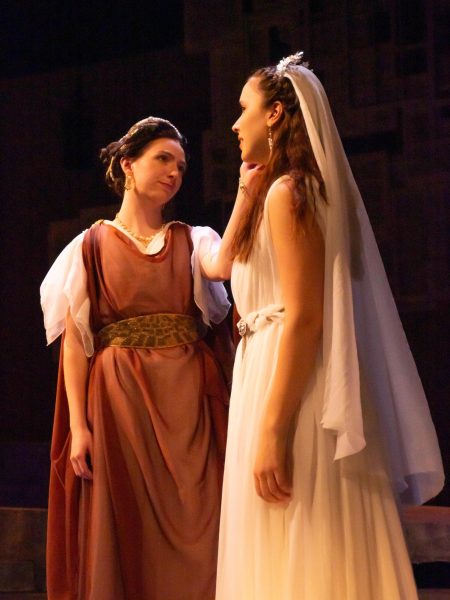
The plot follows the cruelty of Clytemnestra following the murder of her firstborn daughter by Agamemnon. Her sacrificial death was to appease Artemis to bring good winds to sail to Troy. Following her death, Clytemnestra’s grief manifests into rage and resentment toward her other three children. Her children, mainly Electra and Orestes, then conspire to kill Clytemnestra to escape her cruelty.
Whitman’s production featured Sienna Roberts as Clytemnestra, Lena Dozemen as Iphigenia, Nikita Scott as Electra, Julius Kozisek as Orestes and Miriam Slonecker as Chrysothemis.
Senior Nikita Scott described her performance as Electra as an attempt to embody female rage.
“The thing with Electra is you just feel like she’s angry all the time. If you read the script without watching the show, you just get a sense of that. She’s angry, but you really dive in deeper and you really think about that,” Scott said. “She’s not just angry. She’s hurt. She’s upset. She’s sad. She’s grieving. But it’s just all coming out as anger because that is our fight or flight response. [The response] for her is just to be angry at everything.”
Julius Kozisek, a sophomore whose role as Orestes was his debut performance with the theatre department, spoke about his experience acting in a production where almost all of the characters are female.
“I’m this male character and I represent what is supposed to be the epitome of a man who got sent down the gutter of masculinity culture and the military. And to represent that misogyny in a play where that’s the only person representing that is a lot,” said Kozisek.
“I felt like a kid playing in a women’s world that he felt like he didn’t quite fit in. But I think there have been few things that have taught me so much about my relationship to masculinity. […] I think there’s a necessary discomfort with being the one male character in a women’s play,” said Kozisek.
In Ancient Greece, these roles were played by men, for the viewing of men, despite the tragedies featuring many female characters. Women were not even permitted to attend the performances. At the Harper Joy Theater, McLaughlin’s play encouraged a critical engagement with ancient works from modern audience members.