
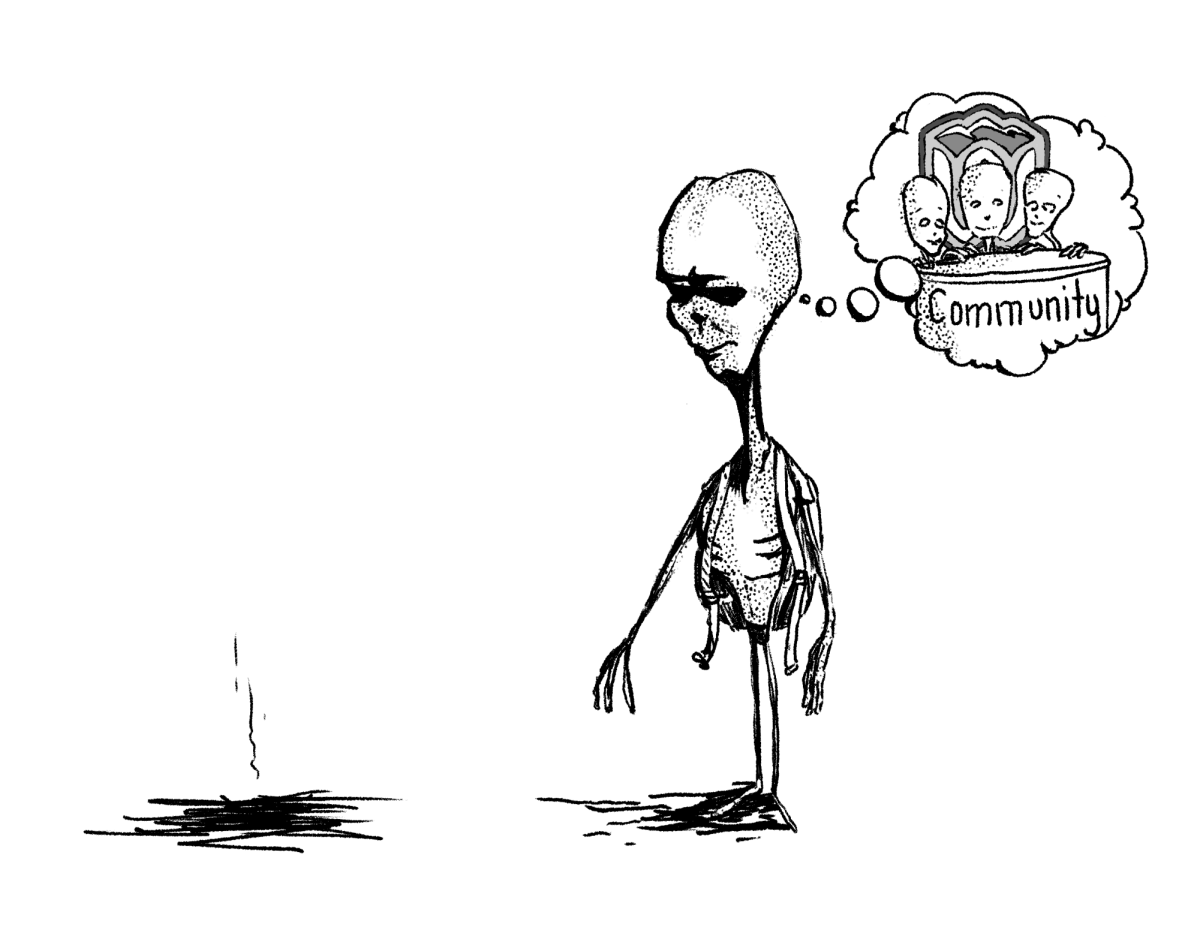
Earlier this week, as I was walking to my next class, I briefly passed by someone I talked to frequently in class. But as I was passing, they kept their heads pointed at the ground while I was awkwardly staring at them, hoping for a wave. It’s understandable that people may have rough days or anxiety, however, this wasn’t the first time I had experienced this behavior, and I know it won’t be the last. Throughout my first-year at Whitman, I have noticed this antisocial behavior that Whitman students have been plagued with. Whitman promises a tight-knit community, where in reality the campus culture is filled with artificial interactions or aloofness.
From my experience, interactions are often surface level and full out redundant small talk. I pass the same few people each week as I go to class, casually stopping for a brief chat and it always ends in “we should hang out” yet neither of us ever follow through. It becomes a reflex instead of a genuine offer. The most frustrating part is the irony of it all. How can 1,500 students share the same dining hall, go to the same parties, walk the same paths to class, yet still feel like strangers? This problem extends beyond Whitman. Gen Z has gotten less social, we keep our heads down at our phones, retreat to our dorms sooner and interact more digitally. Social media has ruined authentic connections and conversations.
When I committed to Whitman at the end of my senior year of high school, I began to add other first-year students on the class of 2029 Instagram page. I quickly regretted it. I now only knew these people through their posts rather than meeting them authentically once I got to campus. I had full conversations on Instagram during the summer, just for these connections to fade instantly as I got to Whitman. While Whitman is such a small school and promotes having this “tight-knit community,” it has the potential to push back against these “norms.” Yet, we have fallen into antisocial behaviors.
As a first-year, it is common to experience loneliness as you inhabit a new environment and have to constantly meet new people and not feel a sense of belonging. However, Whitman further exacerbates this issue. At such a small school, it is difficult to search for people who you feel connected with. Proximity does not lead to connection and familiarity does not lead to friendship. The social options are limited, so if the culture is shallow, you have nowhere else to turn except into these shallow relationships. It is still possible to find valuable connections, Whitman’s culture makes friendships require more effort.
Whitman is not failing institutionally (for event planning) but socially. Whitman student organizations host plenty of opportunities for social interaction, yet turn out is often a struggle.
When I arrived at Whitman I was thrilled to see the amount of student organizations, events planned and this so-called community that was promised. Yet, I have been deeply disappointed with the culture that has been established. Throughout opening week at Whitman I already noticed many groups were already formed, making it hard to merge into. It quickly began to feel like high school cliques all over again. During that week, I talked to as many people as possible as I noticed the repeating patterns of a lack of follow through. First-year students spend hours connecting during orientation just to become strangers. Forced icebreakers and proximity does not always lead to groundbreaking connections— shocker.
Perhaps, I am being pessimistic, but belonging is not impossible to achieve. We are all capable of contributing at a small level to create safe spaces for everyone. Whether it is just a wave, checking in on someone or inviting them to dinner. It starts with something small. Start with extending beyond the small talk, and stop fearing that awkward silence when you are meeting new people. The silence and awkwardness is forming something truly genuine. The culture at Whitman needs reformation. A wave costs nothing but, quietly, it opens doors for belonging.
