
While he was scrolling on Tumblr at 2 a.m., inspiration struck author Aiden Thomas. In just six weeks, Thomas turned his idea into a debut novel, “Cemetery Boys,” which explores LGBTQIA+ identity and has resonated with readers all over the world.
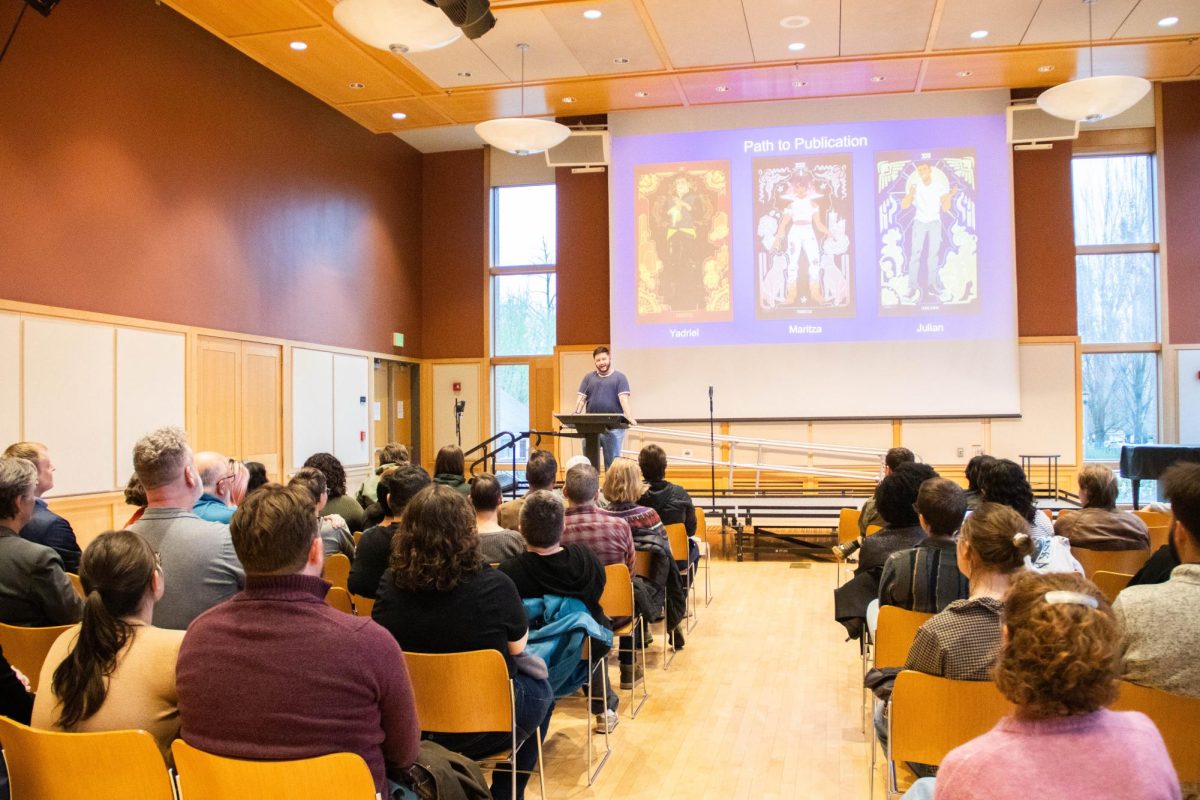
Thomas visited campus on March 31 to celebrate Trans Day of Visibility and discuss his book and journey as a writer. Hosted by Whitman’s Division of Inclusive Excellence, the lecture attracted students, faculty, staff and community members alike.
Published in September 2020, the novel spent four weeks on the New York Times bestseller list, making it the first trans-centered fiction book written by an openly transgender author to achieve the feat.
“Cemetery Boys” is a paranormal romance young adult novel that centers on Yadriel, a transgender, gay and Latine teen who accidentally summons the ghost of a recently deceased fellow high schooler, Julian. The novel follows Yadriel as he fights to prove himself to his traditional family by becoming a real male sorcerer, or brujo, while forming a romantic connection with Julian.
Despite the success of “Cemetery Boys,” positive transgender stories like Yadriel’s are few and far between, according to Director of Whitman’s LGBTQIA+ Student Services Shelby Hearn.
“Historically…and for folks my age and Aiden’s age, a lot of gatherings around queerness and in particular trans identity have often been focused on the violence that trans people disproportionately experience,” Hearn said. “Representation that we’ve seen historically has been through these lenses of trans people as villains or victims.”
Many stories about trans and queer people have historically been defined by tragedy. Trans Day of Remembrance honors those who have experienced violence and discrimination based on their identity.
Colette Marie, Coordinator at the Academic Resource Center, shared a personal story in an email to The Wire, and why she connects with Thomas’ books.
“I lost a very dear gay friend in the AIDS epidemic in the ’80s. When I was in college, we… spent time together in the LGBTQ community in Spokane, which was very much underground due to the very real threat of violence. We were both writers with all kinds of aspirations, but Lee didn’t feel safe to tell his story,” Marie said.
In an interview with NPR, Thomas explained that his novel adds nuance to discourse about transgender experiences by including characters who learn from his protagonist, rather than immediately rejecting LGBTQIA+ identity. “Cemetery Boys” remains one of the first books to tell a trans story with a happy ending. In addition to Trans Day of Visibility, authors like Thomas aim to change narratives about queer identities to center life, joy and acceptance.
“Trans Day of Visibility came into being … to celebrate trans people while they’re here and alive with us,” Hearn said.
With more than 285,000 copies sold, readers love and connect with the joy and magic of Yadriel’s story. For Whitman first-year Ace Cornish, Thomas’ characters helped them feel less alone and more confident in their own skin.
“I read ‘Cemetery Boys’ for the first time when I was younger, and I think it was probably the first book that I ever read with a trans main character, probably with a trans character in general. It was really special to me because I am also trans and I had never seen myself represented,” Cornish said.
Hearn agreed, explaining how representation in literature was critical to their own identity and sense of self, drawing on their experience as a trans person.
“When I was young, I remember… grasping at the merest flickers of something that felt like me… It would have saved me quite a bit of agony in my early 20s of trying to figure out who I was and who I wanted to be,” Hearn said.
Hearn works with the Queer Resource Center (QRC) to create spaces for trans students to feel a sense of safety and belonging, such as their weekly trans affinity space on Mondays from 5 p.m. to 6 p.m., and events on campus.
The QRC serves a large portion of Whitman’s student body, according to Hearn.
“[A considerable amount] of Whitman’s student population identifies under the LGBTQ+ umbrella, which is a really significant swath. That’s been the case at Whitman for a while…but [visible queer spaces]…are relatively new to campus,” Hearn said. “I think that is really meaningful for a first-year student coming into their adulthood and seeing a space like the Queer Resource Center.”
Cornish added that they appreciate campus resources like these.
“I’ve actually never celebrated [Trans Day of Visibility] before because…I wasn’t in spaces that celebrated it,” Cornish said. “It’s nice to have…recognition and reassurance that we see you, we know you’re there and we care for you.”
For Cornish and other attendees, Thomas’ lecture and novel offered an empowering message. His visit on Trans Day of Visibility presented a positive, joyful story about transgender identity, which many attendees found meaningful compared to other harmful narratives.


