

Last Thursday, Feb. 25, Dr. Jaimee Swift delivered a presentation on Black feminism in an anti-Black world, specifically focusing on feminist efforts in Brazil. Swift is an Assistant Professor of Political Science at James Madison University, where she focuses her work on Black women’s resistance efforts.
Dr. Swift began the presentation by introducing and providing some background information on the invention of “killer bees.” According to the lecture, these honeybees originated in Africa and were brought to Brazil by a biologist, but they escaped their enclosure and began to crossbreed with European honeybees. This led to the birth of Africanized honeybees.
Attendee Faith Culpepper ’28 said she enjoyed the presentation and previously spoke with Swift in an introduction to gender studies class.
“Dr. Swift made the topic of Black Feminism translatable by using bees as a metaphor because it’s something easy to grasp and by using bees as a reference, you don’t inherently have a bias on them or their system,” Culpepper said.
Swift also explained that stereotypes about the bees reflect Black resistance movements like the sisterhood of Our Lady of Good Death in Brazil, which freed enslaved Afro-Brazilian women prior to abolition movements in Brazil. For Culpepper, the sisterhood stood out as an important topic within Swift’s presentation. Culpepper explained that she found the idea of these women’s dedication and fearlessness interesting to learn about.
“[There’s] something really beautiful in being the person that goes out and does something even though it could mean consequences to your life, it could mean sacrificing your time or your money, but it’s a beautiful thing,” Culpepper said.
For Dr. Swift, the Africanized honeybees represent slavery, survival and self-determination. As the bees were subjected to government extermination efforts, they became a metaphor for becoming ungovernable. Stereotypes surrounded Africanized bees and became known as “killer bees.” Dr. Swift furthered this comparison, and described how the bees use their stingers to protect themselves when disturbed.
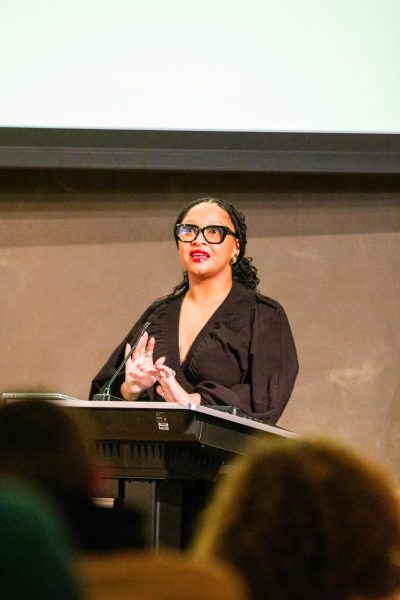
As the presentation came to a close, Dr. Swift summarized her ongoing metaphor with a final question for the audience.
“Are we going to be forced to use our stingers until our death?” Dr. Swift said.
Whitman’s gender studies department hosted Swift’s lecture. Professor of philosophy and literature, IRES and gender studies, Nicole Simek commented on the event as an interdisciplinary lecture. According to Simek, the department often relates to different subjects of study or questions power dynamics and racialization.
“We’re lucky to have had professors who founded gender studies as an interdisciplinary program, who infused it with energy and kept it alive and flourishing over a couple of decades, so there’s a lot of work that we’re building off of,” Professor Simek said.
Simek has worked at Whitman for more than 20 years and witnessed progress and change on campus. As the current director of gender studies, Simek believes the department now has more capacity to plan and develop courses that would be beneficial to students. Simek explained that Whitman has shown its commitment to the department by hiring their first full-time faculty member, Dr. Giramata. This historic moment has provided more opportunities to build a curriculum that focuses on Black Feminism.
Dr. Giramata started working at Whitman in the fall of 2024 and became the first assistant gender studies professor. Their intellectual curiosity and passion lead them to gender studies, specifically Black feminism. Originally, they studied economics and became an economist, but they realized the lack of exposure and visibility of Black feminism in Rwanda and the U.S. Dr. Giramata took action and began to learn more to help educate others.
Giramata first met Dr. Swift through their research and interest in Black feminism. Dr. Giramata’s efforts to educate others on Black feminism have continued since arriving at Whitman. Here, they have organized panels and guest speaker presentations like Swift’s lecture last week. When asked about the goal behind their efforts, Giramata clarified that she hopes to create a more diverse and open space at Whitman
“To increase visibility and awareness of Black Feminism at Whitman. And show students that it is more beyond the borders of Whitman and the United States. There are people doing on-ground work.” Dr. Giramata said.
When it came to planning this presentation and choosing who would present, Dr. Giramata wanted someone who did not just speak on the topic, but was actively involved and doing the work while educating others. This led to the decision of Dr. Swift being the guest speaker, who also happened to be a close colleague and friend. This relatively new discipline has allowed the department to expand its programs and provide more opportunities for the students, like guest-speakers.


