

To introduce more people to the idea of sonification, Assistant Professor of Computer Science Jordan Wirfs-Brock led the Living Data: Sonification Concert with three other performers on Nov. 7 at Chism Hall.
The same way people visualize data into a chart is the same way people can hear data through different volumes, tempo, pitches and noises. Sonification found its start in the late 1980s and researchers have used it to present data using sound. The audiences for sonification performances, however, are not always academic.
The show focused on sounds from the environment, featuring various sets including how elements sound, the rates of deforestation heard through a tree falling beside different notes and a final performance with all the performers creating sound to represent the different types of trees along the campus.
“I really just want to encourage people to think about data and sound in new ways,” Wirfs-Brock said. “Data isn’t just something in a spreadsheet, it’s something that can be creative, used to make art, spark a conversation [and] used to create an experience.”
Wirfs-Brock also visited a music technology class taught by Michael Simon on Thursday with other audio artists, Tristan Peng, Auralee Walmer and Musical Chemist Walker Smith to discuss the theory and creative process behind sonification. The group of visiting artists also hosted a luncheon the day of the concert to talk about their career paths and how they integrate both science and music in their work.
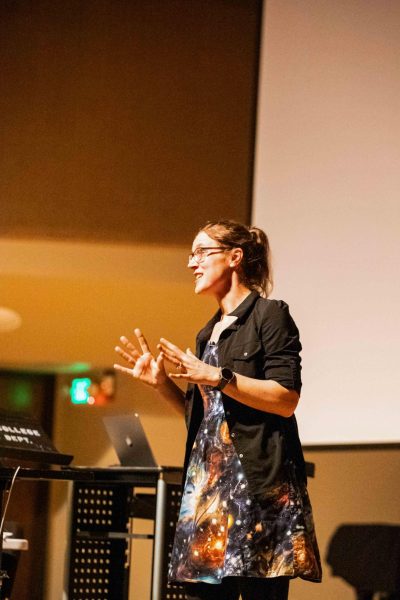
“All of them have created spaces for themselves that are deeply, technically challenging but also extremely playful and technical,” research assistant Sarena Yousuf said. “I feel like you don’t find that in a lot of spaces in academia.”
Wirfs-Brock first encountered the idea of sonification when she worked in public media as a data journalist focused on producing data-driven stories on the radio in 2015. Over years of experience exploring sonification, she realized that uses for the process applied beyond journalism and science.
Through her work, she found that accessibility advocates also used sonification to make the world around them more accessible. Visually-impaired persons who are unable to read data often rely on tactile and auditory cues instead. Sonification provides them a way to engage with data through sound. Through her exploration with different sonification techniques, Wirfs-Brock created the Open Sonifications Manifesto with two other researchers in 2024 to introduce and expand the concept as a form of human-centered design between human analysts and data presented on computers.
“We’re trying to bring this to more people and out of the ivory tower,” Wirfs-Brock said. “You don’t need a fancy tool to make sonification, you just need to be curious and able to make sounds.”
The concert introduced attendees to the concept of sonification while combining technology and music. Smith explained that opportunities to experience data sonification concerts are few and far between, and the first time he was able to go to one it was international.
“I just wish I would have had access to this kind of thing,” Smith said. “Because I felt like it would have broken the part of my brain that is like, ‘Oh, these are two separate fields.’ I think it’s important to see people’s different approaches to blending the technical, the creative and the playful.”
In the past, Smith and Wirfs-Brock have also spoken at the sixth Annual Project Fibonacci Steam Leadership Conference, where they presented on sonification and its immersive approach to relaying data for a group of high school students. Now, they hope to engage with college students.
“I think it’s also cool to be able to do this for college audiences where we might be exploring a little more of the nuances or even talking about the field as a whole,” Smith said.
The “Living Data: Sonification Concert” provided a way to learn about how science and technology can collaborate with music and art. The event combined two different departments on campus and gave students, faculty and community members a chance to interact and interpret data through sound.


