

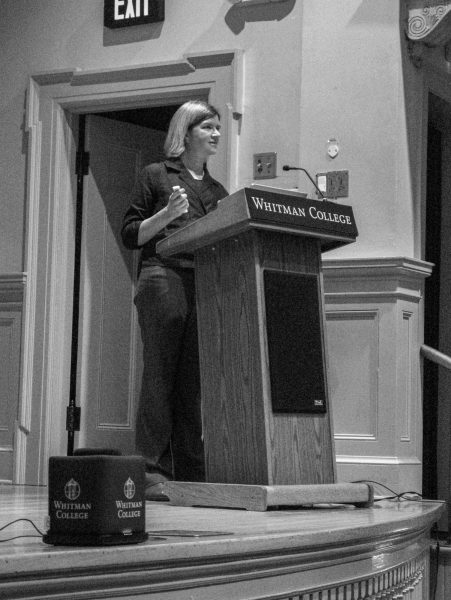
On Tuesday evening, Nov 4th at Whitman College, students and faculty gathered at the Kimball Theatre in Hunter Conservatory to hear Dr. Shannon Cram deliver her talk “On Telling Contaminated Stories.” The lecture unpacked the enduring legacies of nuclear contamination and how societies narrate those legacies. Dr. Cram emphasized the lasting impact of nuclear testing through her study on cleanup efforts.
“It is important to remember that cleanup is not simply the epilogue to nuclear history, it is an active and ongoing set of relationships situated in history and power,” Cram said.
Her remarks drew on long-term analysis of the Hanford Site in Eastern Washington, once a key plutonium-production complex, now the site of one of the nation’s largest environmental cleanup efforts.
“Reckoning with that ongoing-ness means telling stories of the bomb that extend beyond the immediacy of the mushroom cloud. It means engaging with both the eternal legacy of nuclear waste and the logics of ‘reasonable harm’ that produced these materials in the first place,” Cram said.
Dr. Cram’s presentation raised questions about recent policy shifts to resume nuclear testing after a more than three-decade hiatus as announced by Trump on Oct. 30.
Her talk layered local and global contexts – the story of Hanford’s multi-millennial waste streams and cleanup regimes, as well as the implications of a revived nuclear testing regime abroad. She questioned historical narratives about nuclear harm, asking who is viewed as harmed, whose protection is deemed “reasonable,” and which futures get imagined.
Physics Faculty Fellow Zarif Rahman shared insight from his background in nuclear reactions and nuclear astrophysics. He emphasized that the kind of nuclear research he conducted produces very little radioactive waste compared to weapons testing or large-scale industrial nuclear activity.
“Everything is pretty controlled,” Rahman said. “We do not produce a lot of radioactive material after the reactions. Everything is self-contained. In the nuclear chemistry department, they do something called isotope harvesting; collecting unused radioactive materials from experiments and studying them for applications in medical science and other areas.”
Even in Rahman’s controlled research environment, which involves significantly less nuclear waste than large-scale projects like Hanford, where two-thirds of high-level nuclear waste in the US is stored, strict safety measures are in place to protect anyone involved from exposure.
“Anytime there is even a slight possibility of radiation, no one is allowed near the reaction area. Everything is taped off. The radioactive materials we used were stored in one fixed room, where we measured the activity every day…” Rahman said. “Weaponization is a different area, and I don’t want to speak too confidently, but I feel there may be fewer safety measures there. In the science community, though, we take every precaution we can.”
Rahman’s focus on controlled experimentation contrasted with the broader societal and historical narratives Dr. Cram explored. In her talk, Dr. Cram argued that the significance of resumed nuclear testing isn’t merely technical but narrative.
From the Hanford Office of Communications, Erica Thornton offered insight on how cleanup operations communicate with communities and regulators who call this area home.
“After more than 40 years of cleanup, considerable progress has been made at Hanford, reducing the risk the site poses to the health and safety of workers, the public and the environment,” Thorton said. “Hanford’s Environmental Surveillance Program measures radionuclide concentrations in air, surface water, sediment, soil, vegetation, agriculture products, fish and wildlife. Monitoring data are published in the Hanford Site Environmental Report.”
Dr. Cram emphasized that the longevity of nuclear waste makes tracking the cleanup progress difficult. The plutonium isotope used at Hanford has a half-life of over 24,000 years.
“Hanford’s Long-Term Stewardship Program ensures ongoing monitoring, inspections and protectiveness of completed cleanup remedies. In addition, Five-Year Review reports evaluate whether cleanup remedies remain protective of human health and the environment,” Thorton said.
These voices reinforce Cram’s concern – contamination and remediation are not concluded stories but active ones.
As Dr. Cram finished her talk, she invited the audience to reflect on how they live in a world shaped by past decisions whose consequences may outlast them.
In a moment when U.S. nuclear policy appears poised for change, recording and collecting data on the effects of militarized nuclear testing has led scientists to discuss the tangible and historical impact of nuclear policy.


