
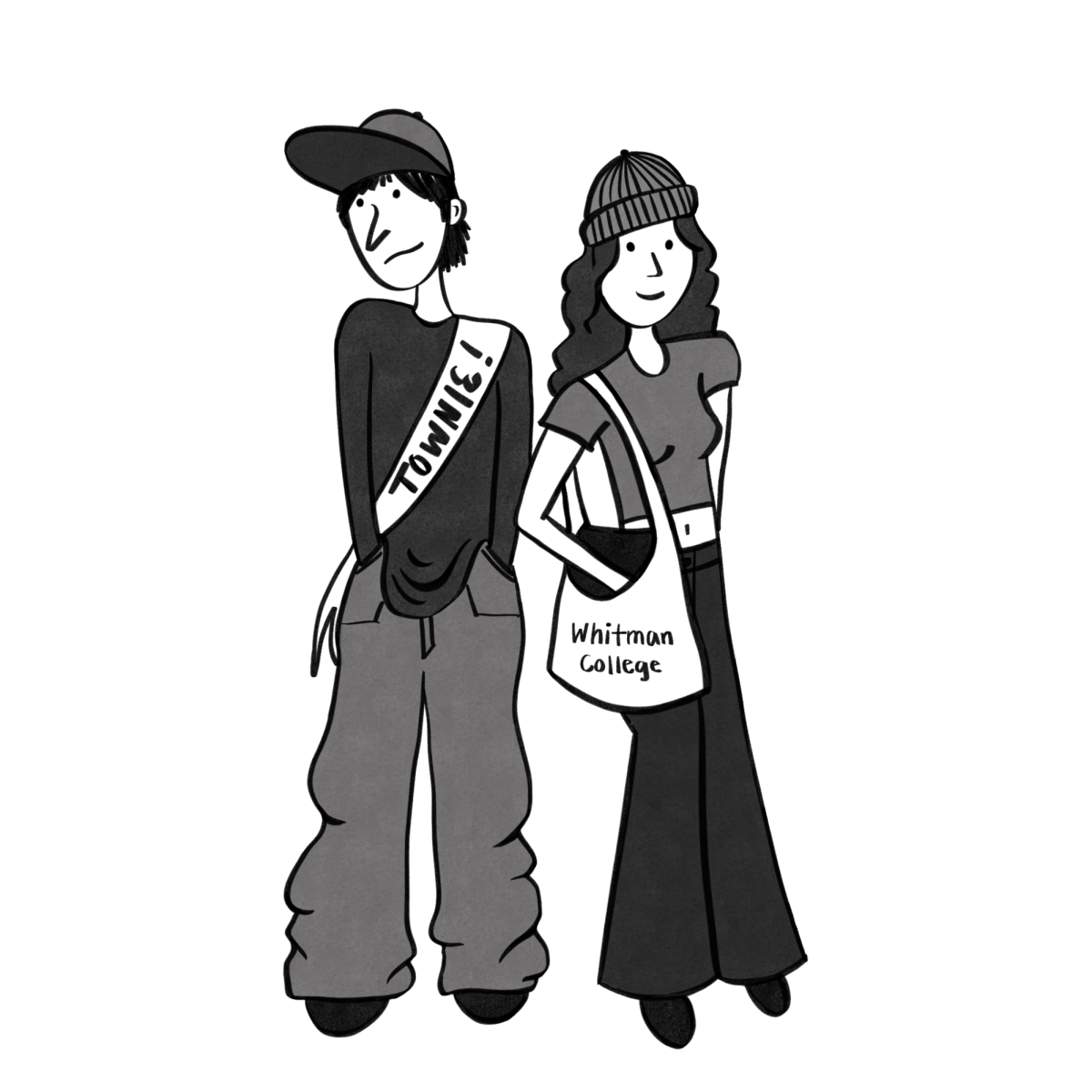
Walk into any Whitman party long enough, and you’ll hear the word “townie” whispered with a mix of irritation and unease. It’s shorthand for a whole constellation of assumptions: dangerous, creepy, unwelcome, out of place. The term gets tossed around so casually that it’s easy to forget how loaded it actually is. In recent months, it has taken on a sharper edge. There have been real incidents at parties, including aggressive behavior, repeated harassment and even someone showing up with a gun. Those events shook students’ sense of safety, especially women, and they aren’t exaggerations.
But acknowledging those risks isn’t the same thing as explaining the reaction to any unfamiliar face. The fraternities that check IDs at the door are responding to liability and real concerns. Still, the panic that spreads when “Walla Walla” shows up on Isaacs isn’t simply a rational response to danger. It’s also about culture, class and the strange insulation that comes with attending a private liberal arts college in a small town. Safety concerns might justify a locked door or a turned-away guest, but they don’t explain why “townie” has become a catch-all dismissal. The word signals something deeper – an anxiety about anyone who doesn’t fit Whitman’s social mold.
That anxiety becomes even more obvious when the label is applied not just to random adults drifting toward campus, but to students from Walla Walla University or the Community College. These are people our own age, going to school a few miles away, yet Whitman students often slot them into the same category as older locals or unruly teens cruising around campus. A generation ago, it seems, WWU and CC students attended Whitman parties with little friction. Now the lines have hardened. The town-gown divide has widened.
COVID-19 didn’t create that divide, but it accelerated it. Students learned to keep their circles small, their environments controlled and their trust selective. Some of that caution has calcified into a culture of suspicion, where unfamiliarity itself feels dangerous. We don’t know these people; they don’t know our norms, and alcohol intensifies every misread social cue. But some of the discomfort is less about safety and more about unfamiliarity. Whitman students are quick to frame tension as danger, and once fear enters the equation, the label “townie” becomes an easy label for everything that feels wrong.
Whitman is proud of its progressive identity, yet it’s also a social enclave populated largely by students from cities, suburbs and financially secure families. Many Whitman students engage with Walla Walla as a landscape, visiting wineries, restaurants and hikes, rather than as a broader community. The people who live here year-round remain blurry in the background. As a result, someone showing up to a Whitman party from “outside” throws the balance off. It disrupts the tacit script that weekend social life is for Whitman students only.
Part of what’s happening here is basic sociology. When someone unrecognized walks into a frat party, students aren’t just assessing risk; they’re assessing difference. The difference is read instantly: clothing, accent, social confidence, race, gender, who they’re talking to and how they move through the space. And that instinct, even when grounded in real concerns, is also shaped by class-coded expectations of who belongs in Whitman spaces.
And that’s where the word “townie” does its damage. It collapses every kind of outsider — WWU students, CC students, locals, young adults, older adults — into a single caricature of threat. It lumps together people who behave poorly with people who have done nothing except not attend Whitman. That flattening effect makes it harder to talk honestly about what’s actually going on. It also allows class anxieties to hide behind the language of “safety,” even when the two are not the same.
To be clear, boundaries at parties are necessary. Whitman absolutely should maintain them. The question is how to maintain them without turning an entire town into an object of suspicion. Ditching the word “townie” would be a start. So would acknowledging that Whitman’s student body holds biases that shape who feels “safe” and who feels “unsafe.” And instead of shutting out WWU and CC students wholesale, Whitman’s social scene might benefit from clearer communication, shared expectations or even occasional collaboration. Familiarity does more for safety than fear ever will.
The people outside our bubble aren’t abstract dangers. They’re neighbors, classmates, workers, parents, friends and sometimes, yes, people who make bad decisions at parties, just like Whitman students do.
Maybe this is the senior in me having my “old man yells at cloud” moment, but the point holds. If Whitman wants to live up to the ideals it advertises, it needs to confront this tension honestly. Fear has its reasons; the label “townie” doesn’t.

A.D. • Nov 25, 2025 at 10:48 am
Thank you for saying this Arham. The use of the word townie and other stuff like that is one of the largest displays of ignorance at Whitman, and it has been allowed to continue without any sort of check for too long. It’s a big reason why many students become disillusioned with this school, and disillusioned with the community that it fosters. If Whitman wants to continue to prepare students to be respectful and collaborative leaders civil servants, they need to make sure students are treating their (temporary) home, Walla Walla, with respect.